
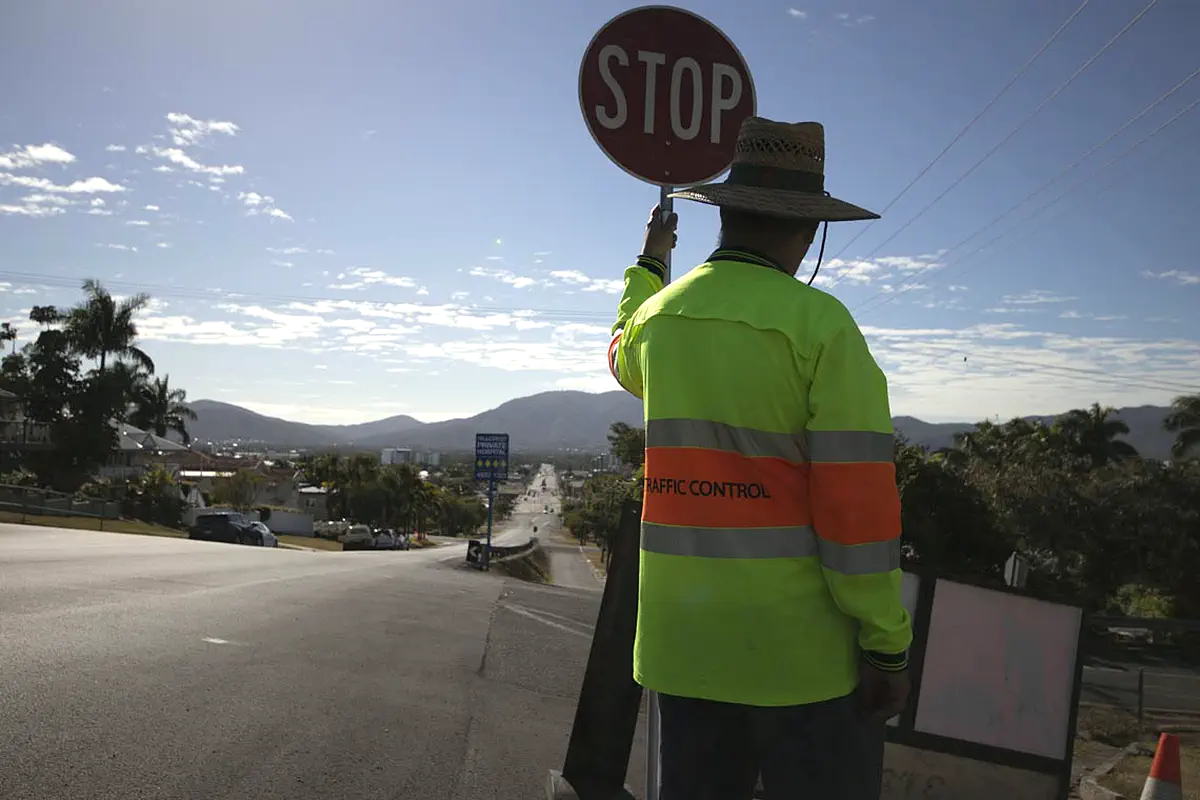
Safety and compliance at East Coast Traffic Control
In short: East Coast Traffic Control is certified to ISO standards for quality, safety and environment, and prepares traffic management plans and traffic guidance schemes to Queensland Department of Transport and Main Roads (TMR) and Transport for NSW (TfNSW) requirements. Every crew member holds current state accreditation, every shift starts with a safety briefing, and sites are audited and inspected through the job.
What ECTC is certified and registered for
ECTC's management system is certified to the ISO standards for quality, safety and environment, so the way we plan, staff, equip and review a job is audited by an external certification body rather than described in a tender and forgotten.
For councils, ECTC is an approved supplier to Local Government Procurement (LGP), LGCA and Local Buy, each of which runs its own supplier compliance checks.
Which standards our plans and setups follow
In Queensland, traffic management on roads follows the Manual of Uniform Traffic Control Devices (MUTCD) Part 3, Works on Roads, together with TMR's Traffic and Road Use Management (TRUM) manual and the Queensland Guide to Temporary Traffic Management (QGTTM). Our TMPs and TGS drawings are prepared to those documents, and our Traffic Management Implementers (TMIs) set out and supervise schemes under them.
In New South Wales, work follows Transport for NSW's Traffic Control at Work Sites (TCAWS) standard, TS 05492:1.0. NSW crews hold the SafeWork NSW Traffic Control Work Training card in the class for their role: Traffic controller (TCR), Implement traffic control plans (IMP) or Prepare a work zone traffic management plan (PWZ).
Because the two states use different manuals and different accreditations, ECTC does not move a Queensland-only crew onto NSW work or the reverse. Each depot staffs jobs with people licensed for that state.
Accreditations our people hold
Every person on an ECTC site holds the current accreditation for the role, issued by the state scheme through an approved RTO. ECTC does not issue accreditations.
| Role | Queensland | New South Wales |
|---|---|---|
| Traffic controller (stop/slow, site control) | Traffic Controller (TC) under the TMR Traffic Controller Accreditation Scheme | Traffic Controller (TCR) |
| Set out and supervise the scheme on site | Traffic Management Implementer (TMI) | Implement Traffic Control Plans (IMP) |
| Design the plan | Traffic Management Designer (TMD) | Prepare Work Zone Traffic Management Plans (PWZ) |
| Truck Mounted Attenuator driver | TMA driver training and licensing | TMA driver training and licensing |
| Site access | Construction induction (White Card) | Construction induction (White Card) |
How safety is managed on every job
The same sequence runs on a two-hour utility job and a 36-hour highway closure.
Plan before anyone leaves the yard
Every job starts with an approved Traffic Management Plan: signage layouts, detours or lane closures, pedestrian and emergency access, timeframes and the standards it complies with. Our planning team works with the client, the council and the state authority until it is signed off.
Assess the site
Road width and shoulders, sight lines, speed zones, entry and exit points and environmental factors such as trees, drains and poles are checked, by mapping or on the ground, so the equipment and crew match the site, not a template.
Check the gear
Cone deployment trucks, utes with arrow boards, VMS trailers, signage packs, barriers, portable traffic signals, radios, lighting and PPE are checked and loaded by depot staff. Each item is checked before it leaves the yard.
Brief the crew
Crews are allocated by accreditation, experience with the setup, travel distance and fatigue, and familiarity with the region. Each shift opens with a safety briefing covering the TMP, the site map, client instructions and the day's hazards.
Audit and adjust
The TMI checks sight distances, tapers and buffer zones against the scheme, documents the setup and adjusts it when conditions change: a school zone opening, an early delivery, weather. Site audits and inspections continue through the job.
Record and review
Daily checks and any incidents are logged through our compliance software so the record is complete when the client, the authority or our certifier asks for it. Hazards and near misses feed back into the next briefing.
Equipment that protects the crew
On high-speed roads the setup includes a Truck Mounted Attenuator (TMA) where the authority specifies one. Since 2025 ECTC has had its own licensed TMA drivers, so 80, 100 and 110 km/h work is staffed and protected without waiting on a subcontractor. Cone deployment trucks let crews set up and pack down without handling every cone on foot in live traffic, and the fleet was renewed in 2024 with 30 new utes across the depots.
Looking after our people
Traffic controllers work outdoors in heat, rain and at night, often far from the depot. ECTC employs a WHS and Wellbeing Manager who visits remote crews, most recently at Roma in inland Queensland, to cover heat safety and hydration, snake awareness and remote-site procedures, and to train crews on the compliance software used for daily checks and incident reporting. Fatigue is managed through crew allocation and travel planning, and team leaders are relieved on long jobs.
Safety performance is recognised as well as measured. Two ECTC controllers received CMC Civil and Mining safety awards on the Bruce Highway Benaraby works in 2020, an ECTC TMI received the same award on the Clarke Creek Wind Farm project in 2022, and Traffic Controller of the Year was the headline award at ECTC's inaugural awards night.
Common questions
Is East Coast Traffic Control ISO certified?
Yes. ECTC's management system is certified to the ISO standards for quality, safety and environment, and the certification is maintained through external audits. Certificate details can be supplied for tenders and prequalification on request through the contact page or sales@ectc.com.au.
Are ECTC's traffic management plans accepted by TMR and Transport for NSW?
ECTC prepares TMPs and TGS drawings to the Queensland MUTCD Part 3 and TMR requirements and to Transport for NSW's Traffic Control at Work Sites standard, and lodges them with the relevant authority or council for approval. Our planning team handles revisions requested by the authority before works start.
Do your traffic controllers hold current licences?
Every person on an ECTC site holds the current accreditation for their role in the state they are working in: TC, TMI or TMD in Queensland, TCR, IMP or PWZ in New South Wales, plus a White Card. ECTC does not issue these accreditations; they come from approved registered training organisations under each state scheme.
Can a Queensland traffic controller work on a NSW job?
Not on a Queensland ticket alone. Traffic controller accreditation is state-based and there is no automatic recognition between Queensland and New South Wales. ECTC staffs NSW jobs with NSW-accredited people and Queensland jobs with Queensland-accredited people, which is one reason the depots are organised by state.
What happens if conditions change during the job?
The Traffic Management Implementer on site is responsible for the scheme in real time. If a lane needs to close, a school zone opens or weather cuts visibility, the TMI adjusts the setup within the approved plan, documents the change and calls the Area Manager if the plan itself needs revising. Crews can be scaled up from the local depot.
Need crews on site?
Send the job and your local Area Manager takes it from there, day or night.