
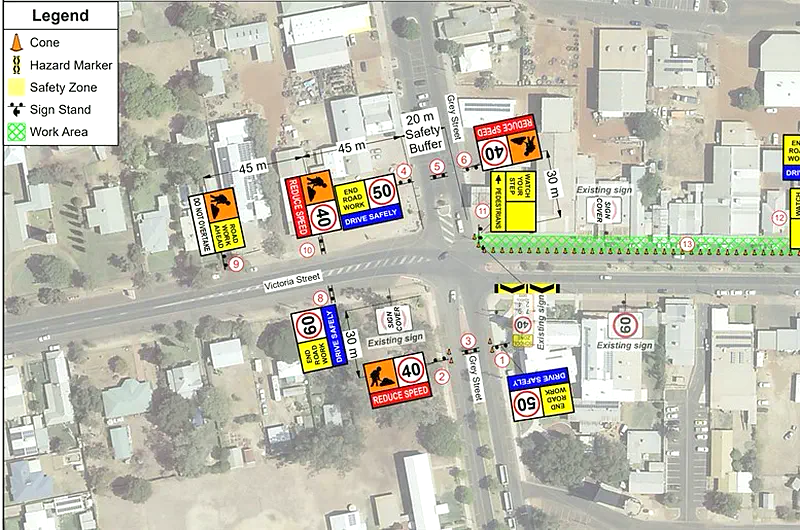
Traffic Management Plans (TMP)
In short: A Traffic Management Plan (TMP) sets out how traffic, pedestrians, cyclists and workers will be managed across the life of a project: scope, phases, risk assessment, roles, contingencies, road authority communication and the Traffic Guidance Schemes attached. ECTC's in-house Traffic Management Designers prepare TMPs to TMR's MUTCD Part 3 and QGTTM in Queensland and the Transport for NSW framework in NSW, and lodge them.
What a traffic management plan is
A Traffic Management Plan is the overarching document for a job on or beside a road. It describes how the risks created by the works and by passing traffic will be managed, across every phase, for everyone affected: drivers, cyclists, pedestrians, public transport, emergency services, nearby businesses and the crew. It is the document the road authority reads to decide whether the works can proceed, and the document an auditor checks the site against afterwards.
The TMP is not the drawing. The drawings are Traffic Guidance Schemes, and a TMP has one or more attached. On a short council job the scheme may be all that is required; on a state-controlled road or a multi-phase project the TMP is where the authority expects the thinking to be written down. Our guide to the difference between a TMP and a TGS goes through it in detail.
Who needs a TMP
If you are unsure, send the site and works through the planning form. The Area Manager or designer will tell you whether the authority will expect a TMP, a TGS only, or an existing scheme reused.
- Any works on a state-controlled road in Queensland (TMR) or on roads delivered for Transport for NSW
- Larger or multi-phase council projects: streetscapes, intersection upgrades, reseal programs across a network
- Civil and infrastructure projects with changing work zones: duplications, bypasses, bridges, pipelines
- Events that close roads, create pedestrian crossings of live lanes or change parking and access
- Utility programs that repeat across many sites, where a program TMP with generic schemes saves a new plan for every pit
- Any job where the principal contractor's safety system or the client's contract requires one
What a compliant TMP contains
- Scope and duration of the works, broken into phases where conditions change
- Site description: road owner and classification, posted speed, geometry, sight distance, intersections, bus routes, schools and businesses
- Risk assessment for each phase covering traffic volumes, speed environment, pedestrian and cyclist movements and plant
- Roles and responsibilities, naming who holds which accreditation on site (TC, TMI, TMD) and who the road authority contact is
- Traffic Guidance Schemes for each activity, drawn to scale and referenced to the posted speed
- Provisions for pedestrians, cyclists, public transport, emergency vehicles and property and business access
- Contingency arrangements for incidents, breakdowns, weather and queue management, including end-of-queue protection where required
- Communication protocols between the TMI, the principal contractor and the road authority
- Hours of work, staging of setup and pack-down, and public notification where the council requires it
- Version control log and sign-off by the Traffic Management Designer
How we prepare and lodge a TMP
Brief and site review
You send the site, works, dates, hours and any existing documents. A designer reviews the site physically or by mapping and identifies the road authority, the permit path and the phases.
Design
The designer draws the TGS for each phase to the state's current edition and writes the TMP around them. Any variation from a 'shall' or 'should' requirement is documented with a risk assessment and, in Queensland, RPEQ certification where TMR requires it.
Lodge
We lodge with the TMR district, Transport for NSW or the council, and with Queensland Police and TransLink where a closure or bus route is involved. The permit register records the submission and the estimated decision date.
Respond and approve
If the authority asks for further information we answer it. Approval comes back with a permit number, start and expiry dates. Permits in Queensland are typically valid for the works period and need an extension if the program runs over.
Brief the crew
The approved TMP and schemes are briefed to the TMI and controllers before the first shift. If the site changes, the designer revises the TGS and, where needed, amends the permit before the next phase.
TMPs in Queensland: TMR requirements
Queensland plans follow the Manual of Uniform Traffic Control Devices Part 3, Works on Roads, published by TMR, which sets out how AS 1742.3 applies in the state, together with the Queensland Guide to Temporary Traffic Management. Since the March 2025 update, designers must specify exact sign distances where tolerances could compound, end-of-queue protection is mandatory in 80 km/h and faster zones or where visibility is limited, multi-message sign layouts and detour signage follow new rules, and any variation needs a documented risk assessment, often with certification by a Registered Professional Engineer of Queensland holding TMD competency.
Works on a state-controlled road need a TMR district permit, which our register shows at about ten business days from a complete submission across the districts we lodge with. Council roads need the council's own works-on-road approval. See our guide to MUTCD Part 3 in Queensland.
TMPs in New South Wales: Transport for NSW requirements
New South Wales plans follow Transport for NSW's Traffic Control at Work Sites (TCAWS) standard, TS 05492:1.0, which replaced the Issue 6.1 Technical Manual in June 2026 and applies to temporary traffic management on all public roads in NSW. TfNSW publishes TMP templates and review checklists, and where TCAWS and AS 1742.3 differ, TCAWS prevails. NSW runs its own accreditation for people who prepare and implement plans, and a Queensland qualification does not carry across. Our NSW plans are prepared and implemented by NSW-accredited people from our Coffs Harbour, Dubbo, Young, Wagga Wagga and Tumbarumba depots. See TfNSW traffic control at work sites.
What you supply
The site address or chainage and the road owner if you know it. A description of the works and the plant that will be on the road. Start date, hours and duration. The principal contractor's name, site rules and any road authority correspondence to date. The layout you expect: shoulder works, lane closure, T or four-way intersection, roundabout, full closure. Drawings, aerials or a previous TMP for the same site if they exist. That is enough for a designer to start; we will ask for anything else on the first call.
TMPs we have prepared
A six-week design process with TMR for the full Bruce Highway closure in Rockhampton for Queensland Rail, with the schemes revised through last-minute changes before 22 controllers and 18 utes put the closure in. Project plans for the Smithfield Bypass and Cairns Western Arterial Road duplication for TMR contractors. Event TMPs for the Tones and I concert in Young and council events in Rockhampton and Gympie. Aurizon's track maintenance supervisor wrote that our team completes their traffic management plans to suit the requirements of local laws; Century Cranes has relied on us from the TMP through to the crew for many years.
Planning from our depots
Common questions
How much does a traffic management plan cost?
It depends on the number of phases and schemes, the road authority involved and how much site review is needed. A single-scheme council job is priced very differently from a staged highway closure. Send the site, works and dates through the planning form and the designer will quote the plan, with the permit fees the authority charges shown separately.
How long does TMP approval take?
Design time depends on complexity. Authority turnaround is on top: our permit register shows TMR district permits at about ten business days from a complete submission, council approvals from five to 28 business days depending on the council, and Queensland Police road closure permits around five. Lodging a complete plan the first time is the biggest factor in hitting the date.
Who approves a traffic management plan?
The road owner. TMR's district office for Queensland state-controlled roads, Transport for NSW for its roads and projects, and the council for local roads, with Queensland Police for full closures and TransLink where buses are affected. Where a job touches both a state road and a council road, both approve.
Can I reuse a TMP from a previous job?
Only if the site, works and standard are the same, and the authority accepts it. A plan from a different road, or one drawn before the March 2025 Queensland changes, usually needs revision. Send it to us and the designer will tell you what can be kept and what must change.
Does the TMP have to be prepared by an accredited designer?
Road authorities expect plans prepared by a qualified Traffic Management Designer, and in Queensland certain variations also need RPEQ certification. A plan prepared by someone without TMD qualifications is a risk the client carries at audit. ECTC's TMPs are prepared and signed by accredited designers for the relevant state.
Do you prepare the TMP and then supply the crew?
Yes, and that is the point of having all three tiers in-house. The designer who drew the scheme briefs the TMI who sets it out. If you prefer, we prepare the plan for your own crews or another contractor to implement, or implement a plan prepared by someone else.
Need crews on site?
Send the job and your local Area Manager takes it from there, day or night.