
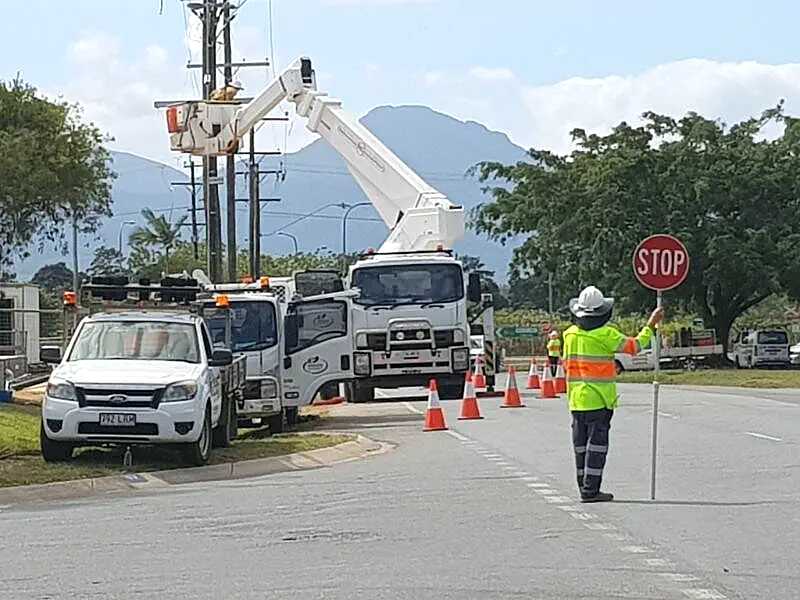
Utilities and energy traffic control
In short: ECTC provides traffic control for utility and energy work across Queensland and New South Wales: reactive and planned powerline works for distributors and their contractors, water main and sewer programs, telecommunications pits and cabling, and site access and oversize movements for solar, wind and battery projects, including the Clarke Creek solar and wind farms and the Callide C4 transformer move.
Who this is for
Electricity distributors and their maintenance contractors, water authorities and pipeline contractors, telecommunications carriers and their civil subcontractors, generation companies and the EPC contractors building solar, wind and battery projects, and the heavy haulage operators moving transformers and turbine components through regional towns.
Utility work has a shape of its own. A lot of it is reactive: a fault, a storm, a pole that needs replacing today. The rest is programmed but spread across dozens of small sites, each one on a different road with a different authority. Both need a traffic control company that answers the phone at night and can draw a TGS for a two-hour pit job without treating it as a project.
What is included
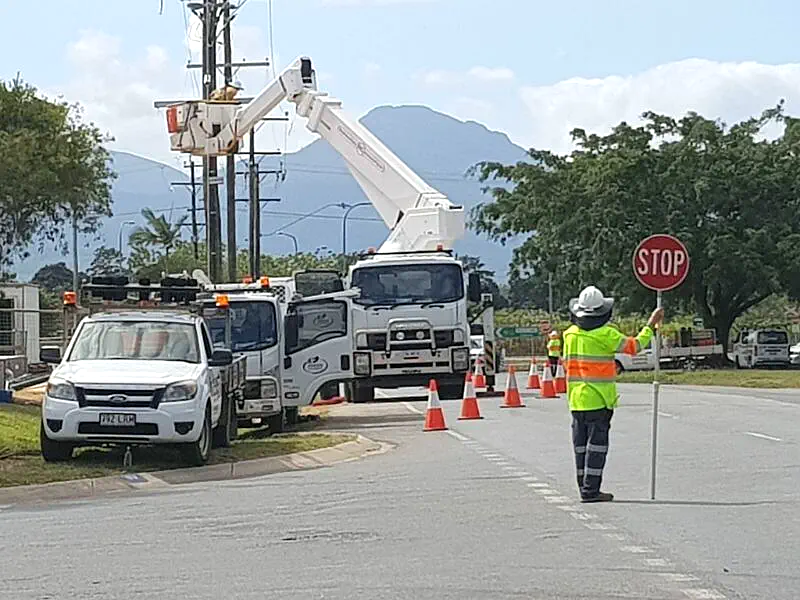
- Reactive call-out crews for powerline, water and telecommunications faults, day or night, from the nearest depot
- Programmed crews for maintenance runs, pole replacements, mains renewals and cable hauls across multiple sites
- Traffic Guidance Schemes for each site and a program TMP where the work repeats across a network; permits lodged with TMR and councils
- Lane closures, shuttle flows and shoulder works with PTCDs where a controller should not stand in the live lane
- Site access control and haul route management for renewable energy construction, including heavy vehicle entries from state-controlled roads
- Traffic management for oversize and overmass movements through towns and along highways, coordinated with police escorts and the road authority
- Pedestrian management around open pits, elevated work platforms and cable trenches in town centres
- VMS trailers, arrow boards, lighting and TMA protection for work on high-speed corridors
How utility work runs with us
Standing arrangement
For distributors and contractors with regular work, the Area Manager sets up the call-out process once: who rings, what information to give, and which depot responds for each area. Our Ventia powerline work runs this way across every Queensland depot.
The call
Location, the work, the hours and whether a scheme already exists for that site type. For reactive faults the crew mobilises on the call; for planned work the designer prepares the TGS and we lodge the permit.
On site
Crew arrives early, runs the pre-start with your crew leader, stages the setup, and holds the site. Setups near live electrical work follow your exclusion zones and the TMI coordinates with the person in charge of the electrical work.
Program reporting
Each shift is documented. For programs, the Area Manager reports site by site so your scheduler can see what was covered and what is next.
Compliance on utility sites
The road authority rules are the same as any works on roads. In Queensland, TMR's Manual of Uniform Traffic Control Devices Part 3 and the Queensland Guide to Temporary Traffic Management apply, with a TMR permit for state-controlled roads and the council's works-on-road approval for local roads. In New South Wales, Transport for NSW's Traffic Control at Work Sites framework applies. Our crews hold the accreditation for the state they work in.
Utility work adds the client's own safety system on top: electrical exclusion zones, permit-to-work, confined space entries around pits and the distributor's working-on-roadways rules. Our TMIs are briefed on those before the shift and the traffic setup is designed around them, not the other way round. On the Clarke Creek wind farm, one of our TMIs received the CMC Civil and Mining Safety Award for his work on the project, which is the standard we expect of crews on energy sites.
Utility and energy work we have done
Clarke Creek Solar Farm and Battery, Central Queensland, developed by Yurika with Iberdrola Australia: traffic management planning and on-site control for powerline installation, heavy equipment transport and site access on a 376 MW project with around 645,000 panels connecting to the Powerlink Broadsound substation. Clarke Creek Wind Farm at Marlborough, for CMC, on the Squadron Energy project.
Callide Power Station, December 2022: traffic management for CS Energy on the move of the new Unit C4 generator transformer from the Port of Gladstone to the station, including the final leg from Biloela. Narangba, 2025: planned power works in a live suburban network, with the traffic management plan, signage and speed reductions built around the electrical crew's work area.
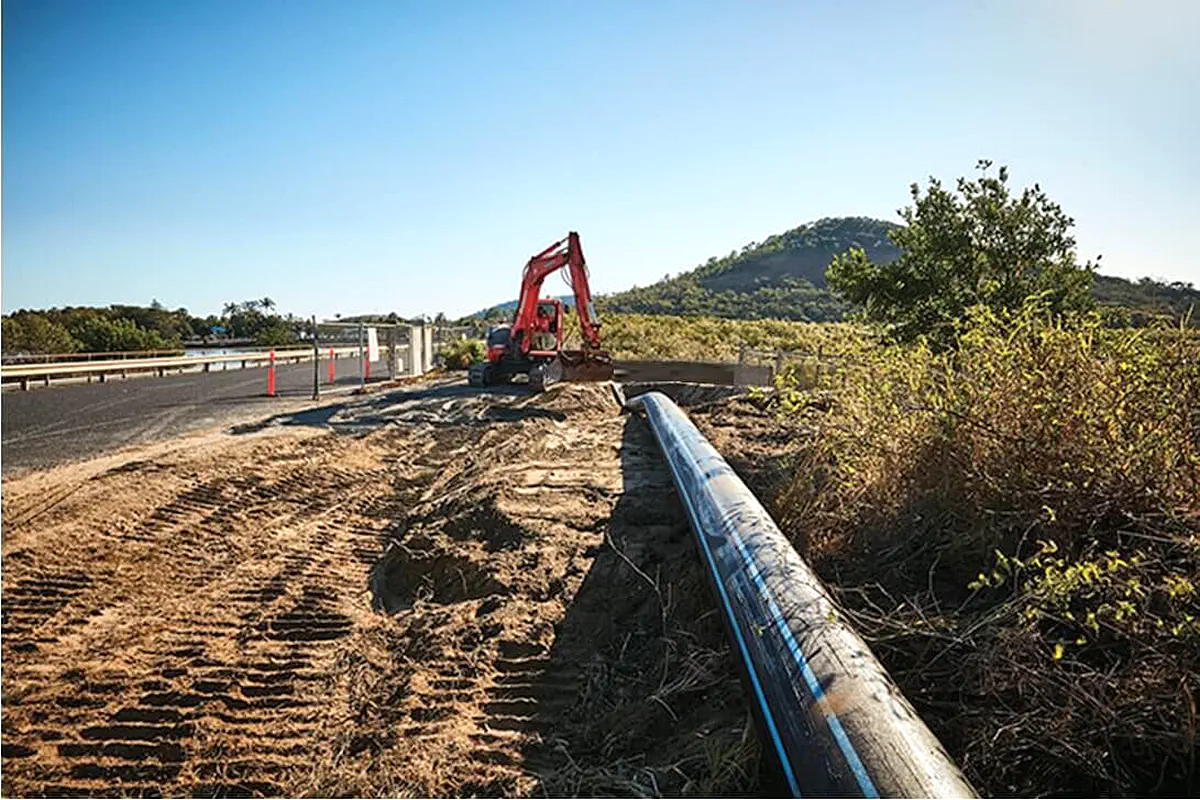
Ventia: powerline works across all of our Queensland depots, around 90 percent of it reactive. Water: the Scenic Highway pipeline for Livingstone Shire Council at Yeppoon, with setups that changed as each section progressed, and the sewer rising main on Toolooa Street, Gladstone. Telecommunications pits and Telstra access are a regular part of the recovery work after storms.
Typical utility jobs and what they need
| Job | Setup | Plan and approval |
|---|---|---|
| Pole replacement or conductor work on a two-lane road | Shuttle flow with TCs or PTCDs, shoulder closure | TGS from the program TMP; council or TMR approval |
| Water main renewal along a town street | Lane closure, pedestrian detour, business access maintained | TGS per section; council works-on-road approval |
| Telecommunications pit or cable haul | Shoulder or footpath closure, short duration | TGS, often from an existing scheme; council approval |
| Oversize transformer or turbine component movement | Rolling closures, intersection holds, escort coordination | Road authority approval and police escort arrangements per movement |
| Solar or wind farm construction access | Controlled site entry from a highway, haul route signage, TMA where high speed | Project TMP with TGS per entry; TMR permit on state roads |
Jobs like this
Closest depots
Common questions
Can you respond to a power fault at night?
Yes. The operations line runs 24/7 and crews mobilise from the nearest depot with lighting, signage and PTCDs loaded. For distributors and contractors we set up the call-out process in advance so the first call gives us what we need. Regions include Far North, Central and South East Queensland, Northern NSW and the Riverina.
Do we need a new TGS for every small utility job?
Not always. For programs with repeating site types, our designers prepare a program TMP with generic schemes for each layout, and the TMI confirms on site that the scheme fits the actual road. A site that does not match gets a site-specific TGS before work starts.
Can you manage traffic for an oversize load movement?
Yes. We have supported the Callide C4 transformer move and heavy equipment transport into the Clarke Creek projects. Rolling closures, intersection holds and VMS warnings are planned per movement with the road authority and the police escort provider.
Do you work inside the distributor's electrical safety rules?
Yes. Our TMIs are briefed on exclusion zones, permit-to-work and the client's working-on-roadways rules before the shift, and the traffic setup is designed around the electrical work area. Any change on site goes through your person in charge before the setup moves.
Do you cover renewable energy sites in remote areas?
Yes. Clarke Creek is between Rockhampton and Mackay and is crewed from those depots. Remote sites are allocated with travel and fatigue built in, and for long programs we can base a crew near the project. Tell us the site and the Area Manager will confirm how it would be crewed.
Need crews on site?
Send the job and your local Area Manager takes it from there, day or night.