
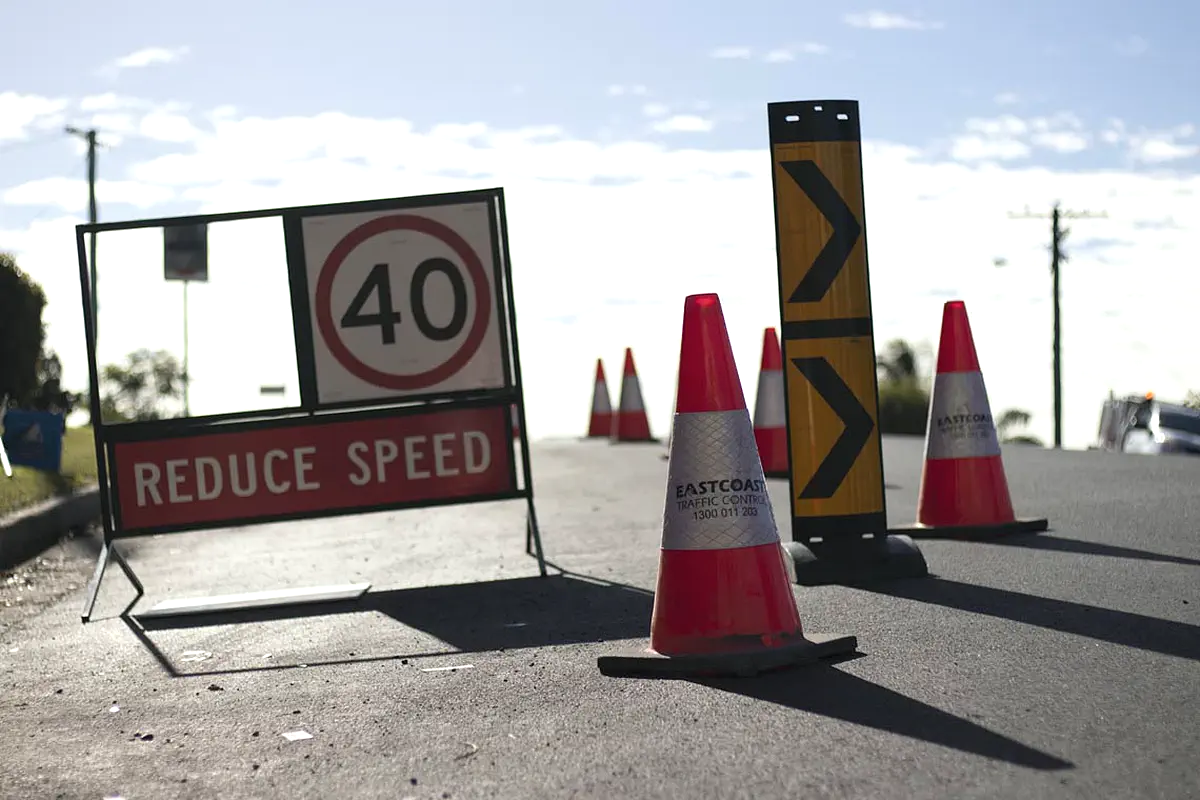
Traffic Guidance Schemes (TGS)
In short: A Traffic Guidance Scheme (TGS) is a scaled drawing of the temporary traffic arrangement for one work activity: advance warning signs spaced to the posted speed, tapers, delineation, controller and portable signal positions, pedestrian provisions and the work area. ECTC's Traffic Management Designers draw site-specific TGSs to TMR's MUTCD Part 3 in Queensland and Transport for NSW's TCAWS in NSW, and our TMIs set them out.
What a traffic guidance scheme is
A Traffic Guidance Scheme is the drawing the crew works from. It shows, to scale, how the road will be arranged while a specific activity happens: where each advance warning sign goes and how far apart, where the taper starts, where cones and barriers run, where the controller or portable traffic signal stands, how pedestrians and cyclists get past, and where the work area and plant sit. Device spacing is set by the posted speed, so a scheme for a 60 km/h town street and one for a 100 km/h highway look very different even for the same works.
A TGS sits inside a Traffic Management Plan on larger jobs, with one scheme per phase or activity. On short, isolated works on a council road, the TGS is often the only planning document the council requires. It is a drawing, not a template: a scheme drawn for a straight rural road and relabelled for a signalised intersection is the most common thing an auditor finds wrong.
When a TGS is enough on its own
Works on a state-controlled road, lane closures on higher-speed roads, full closures, events and multi-phase projects need the scheme attached to a TMP. The difference between a TMP and a TGS is explained in our resource guide, and the Area Manager will confirm which your site needs.
- Short-duration works on a council road: patching, kerb and channel, service pits, footpath repairs, tree works
- Shoulder works with no lane closure on a lower-speed road
- Repeat activities under an existing program TMP, where the generic scheme is confirmed on site by the TMI
- Utility faults and small maintenance where the authority accepts a standard scheme for that layout
What a compliant TGS shows
- Site location, road name and owner, direction of travel and north point
- Posted speed and any temporary speed restriction, with speed signs and END signs placed to the standard, duplicated on both sides where required
- Advance warning signs with spacings to the posted speed, and exact distances specified where tolerances could compound
- Taper lengths, lane widths and the work area with a safety buffer
- Delineation: cones, bollards or barriers, with base weights and separation devices suited to the road and wind
- Positions of Traffic Controllers or Portable Traffic Control Devices, and any Truck Mounted Attenuator
- Pedestrian and cyclist provisions, business and property access, bus stop arrangements
- End-of-queue protection where the speed environment or sight distance requires it
- Multi-message sign panel layouts and detour signage drawn to the current rules
- Designer's name, accreditation, date and version
How we draw and approve a TGS
Site information
You send the location, works, hours and the layout. The designer checks the posted speed, geometry, sight distance, intersections, driveways, bus stops and pedestrian paths on aerials or on site.
Drawing
The scheme is drawn to scale to the state's current edition. In Queensland that is TMR's MUTCD Part 3 and QGTTM; in NSW it is Transport for NSW's TCAWS. Variations are documented with a risk assessment.
Approval
Where the scheme is part of a TMP, it is lodged with the TMP to the road authority. Where a council accepts a TGS alone, we lodge it with the works-on-road application. The permit register tracks the decision date.
Set-out and check
The TMI sets the scheme out in sequence, confirms it matches the site, and escalates to the designer if real conditions differ. A revised scheme is issued before the next shift if needed.
Queensland: TMR requirements for a TGS
Queensland schemes follow TMR's Manual of Uniform Traffic Control Devices Part 3, Works on Roads, and the Queensland Guide to Temporary Traffic Management. The March 2025 edition tightened sign spacing tolerances, required designers to specify exact distances where tolerances could compound, changed multi-message sign rules (for example a Speed Limit AHEAD or END panel must sit in the top position), introduced new detour and U-turn signs, required speed restriction signs to be duplicated on both sides where practicable with repeaters every 500 metres on long or multi-lane roads, and made end-of-queue protection mandatory in 80 km/h and faster zones or where visibility is limited. Our schemes are drawn to that edition. See MUTCD Part 3 in Queensland.
New South Wales: Transport for NSW requirements
NSW schemes follow Transport for NSW's Traffic Control at Work Sites (TCAWS) standard, TS 05492:1.0, which replaced the Issue 6.1 Technical Manual in June 2026 and applies to all public roads in NSW. Where the standard and AS 1742.3 differ, the standard prevails. It sets requirements for temporary speed zones, end-of-queue protection and portable traffic control devices. Many NSW sites still call the drawing a Traffic Control Plan; the current term is Traffic Guidance Scheme and the content is the same. NSW schemes are prepared and set out by NSW-accredited people. See TfNSW traffic control at work sites.
What you supply and what we produce
From you: the site, a description of the works and plant, hours, duration, the layout you expect and any previous scheme for the site. From us: a site-specific TGS drawn to scale with a version log, signed by the designer, lodged with the authority where required, and briefed to the crew that will set it out. For programs, a set of generic schemes for each layout type under a program TMP, with the TMI confirming each on site.
Planning from our depots
Common questions
What is the difference between a TGS and a TMP?
A TGS is the scaled drawing for one activity: signs, spacings, devices, controller positions and pedestrian provisions. A TMP is the project document around it: scope, phases, risks, roles, contingencies and communication with the road authority, with the TGSs attached. Short council jobs often need only a TGS; state roads and larger projects need both.
Can I use a generic TGS from a template?
Only where the road authority accepts a standard scheme for that layout and the TMI confirms on site that the real road matches it. A generic scheme used on a site with different speed, geometry or pedestrian movements is non-compliant. For anything beyond a simple repeat activity, we draw a site-specific scheme.
How long does a TGS take to draw?
A single-activity scheme on a simple site is usually quick once we have the location, works and layout. Complex sites with intersections, bus stops, pedestrian detours or multiple phases take longer, and any road authority approval adds its turnaround. Send the brief and the designer will give you a time for your site.
Does a TGS need road authority approval?
On a council road, the council's works-on-road approval usually covers the scheme. On a state-controlled road the scheme is lodged as part of the TMP to TMR or Transport for NSW. Full closures in Queensland also need a Queensland Police road closure permit. We lodge each and track the decision.
What happens if the site does not match the scheme on the day?
The TMI does not set out a scheme that does not fit. They escalate to the Area Manager and a designer revises the drawing, before the setup goes live. That is the accreditation working as intended, and it is cheaper than an auditor stopping the job.
Need crews on site?
Send the job and your local Area Manager takes it from there, day or night.