
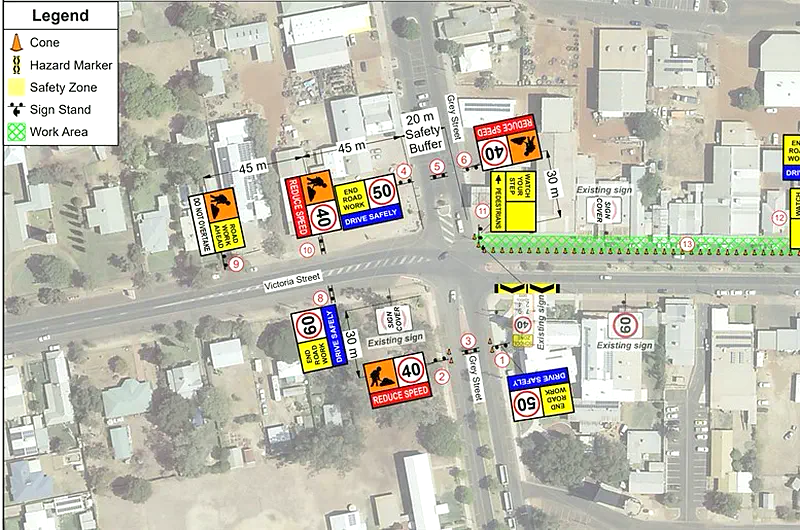
Traffic management planning
In short: ECTC prepares Traffic Management Plans (TMPs), Traffic Guidance Schemes (TGSs) and road authority permit applications in-house for projects across Queensland and New South Wales. Our Traffic Management Designers draw to the current TMR MUTCD Part 3 and QGTTM in Queensland and the Transport for NSW framework in NSW, lodge with the authority, and hand the approved plan to our own crews to implement.
What traffic management planning covers
Before any work can start on a road, somebody has to document how traffic, pedestrians, cyclists and workers will be kept apart and moving, and the road authority has to accept it. That is traffic management planning. It produces three things: the Traffic Management Plan, the Traffic Guidance Scheme or schemes attached to it, and the permit or approval from whoever owns the road.
ECTC has in-house Traffic Management Designers who do all three. We also hold the other two accreditation tiers, Traffic Management Implementers and Traffic Controllers, so the plan that is lodged is the plan the crew sets out. You can book planning on its own, crews on their own, or both.
Which plan do you need?
Three documents, three different jobs. Each page explains who needs it, what it contains, what you supply and how approval works.
Traffic Management Plan (TMP)
The overarching document for a project: scope, phases, risks, roles, contingencies and communication with the road authority. Required on state-controlled roads and larger projects.
Traffic Guidance Scheme (TGS)
The scaled drawing for one activity showing every sign, device and controller position. Often the only document a short council job needs.
Permits and road occupancy
TMR permits, council works-on-road approvals, Queensland Police road closure permits and TransLink notifications, lodged and tracked by us.
TMP, TGS and TCP compared
The terms get mixed up on site. This is how we use them.
| Term | What it is | Who needs it |
|---|---|---|
| Traffic Management Plan (TMP) | Project-level document: how traffic is managed across the life of the works, with phases, risk assessment, roles, contingencies and the TGSs attached | Works on state-controlled roads (TMR, TfNSW), larger council projects, events with road impact |
| Traffic Guidance Scheme (TGS) | Scaled drawing of one work activity: signs, devices, spacings against the posted speed, controller and PTCD positions, pedestrian provisions | Every job, as part of a TMP or on its own for short council works |
| Traffic Control Plan (TCP) | The older NSW term, still used on many sites, for the work site layout drawing; current Transport for NSW documents use Traffic Guidance Scheme. In Queensland, 'TCP' also appears in TMR permit numbers for works on a state-controlled road | Anyone handed a 'TCP' in NSW is holding a TGS; in Queensland, check whether the reference is the drawing or the TMR permit |
How planning works with ECTC
Brief
Send the site, the works, the dates, the hours and anything you already hold: a previous TMP, site drawings, the principal contractor's requirements. Use the planning form on this page, the quote form, or call 1300 011 203.
Site review
A designer reviews the site physically or by mapping: road classification and owner, posted speed, geometry, sight distance, intersections, pedestrian and cyclist movements, bus routes and nearby schools or businesses.
Design
The TGS is drawn to scale to the state's current edition, with device spacings against the posted speed and any variation documented with a risk assessment. The TMP is written around it with phases, roles and contingencies.
Lodge and track
We lodge with the TMR district, Transport for NSW, the council, Queensland Police or TransLink as the job requires, respond to any request for further information, and give you the estimated decision date.
Hand to the crew
The approved plan is briefed to the TMI and controllers who will implement it. If the site changes, the designer revises the TGS before the next phase.
Compliance: TMR in Queensland, TfNSW in New South Wales
Queensland plans are prepared to the Department of Transport and Main Roads' Manual of Uniform Traffic Control Devices Part 3, Works on Roads, which sets out how AS 1742.3 applies in Queensland, and the Queensland Guide to Temporary Traffic Management, TMR's adoption of the Austroads guide. The March 2025 edition raised the bar on sign spacing tolerances, multi-message sign layout, detour signage, end-of-queue protection and the documentation of variations. Plans that look complete but reference the wrong edition or the wrong state are the ones that get knocked back.
New South Wales plans are prepared to Transport for NSW's Traffic Control at Work Sites (TCAWS) standard, TS 05492:1.0 since June 2026, which applies to all public roads in NSW, with TfNSW's own templates for TMPs and checklists for review. Where AS 1742.3 and TCAWS differ, TCAWS prevails. NSW requires NSW-accredited people to prepare and implement plans; our designers and crews are accredited for the state they work in. Our resource guides explain MUTCD Part 3, TCAWS and the difference between a TMP and a TGS.
What you supply, what we produce
From you: the site address or chainage, a description of the works and the plant involved, the start date, the hours and duration, the principal contractor's name and site rules, any road authority correspondence, and the layout you expect (shoulder, lane closure, intersection, full closure). Drawings help but are not essential; a marked-up aerial is often enough for a designer to start.
From us: a TMP in the format the authority expects, site-specific TGSs drawn to scale with a version control log, the permit application and its tracking, and a briefing pack for the crew. For recurring programs, a program TMP with generic schemes for each layout type that the TMI confirms on site.
Planning services
- Permits and road occupancyTMR permits, council works-on-road approvals, police road closure permits and TransLink...
- Traffic Guidance Schemes (TGS)The scaled drawing that shows every sign, device and controller for one work activity. Drawn...
- Traffic Management Plans (TMP)The project-level document that road authorities approve before works start, prepared by our...
Planning from our depots
Common questions
Do I need a TMP or just a TGS?
Short, isolated works on a council road usually need only a Traffic Guidance Scheme. Works on a state-controlled road, larger or multi-phase projects, and events with road impact need a Traffic Management Plan with TGSs attached. The road authority's conditions decide; the Area Manager or designer will confirm for your site.
Can you prepare plans for both Queensland and NSW?
Yes. Queensland plans are drawn to TMR's MUTCD Part 3 and the QGTTM; NSW plans to Transport for NSW's Traffic Control at Work Sites standard, TS 05492:1.0. The states run separate accreditation schemes and separate approval processes, so a plan is prepared for the state the site is in, by people accredited for that state.
How long does a traffic management plan take?
Design time depends on the complexity of the site and the number of phases; a single-TGS council job is quick, a staged highway closure can take weeks of iteration with the authority. Approval adds the authority's turnaround on top. Send the brief and dates and the designer will give you a timeline for your job.
Will you lodge the permit, or do we?
We lodge it. Our permit register tracks each application with the authority, submission date, estimated decision date, approval, permit number, start and expiry. Where the authority requires the principal contractor to be the applicant, we prepare the application and the supporting plan for you to submit.
Can you implement a plan prepared by someone else?
Yes. Our TMIs and controllers implement approved plans from other designers through our traffic controller hire service. The TMI will check the plan against the site and tell you if a scheme needs revising before it goes on the road.
Need crews on site?
Send the job and your local Area Manager takes it from there, day or night.