
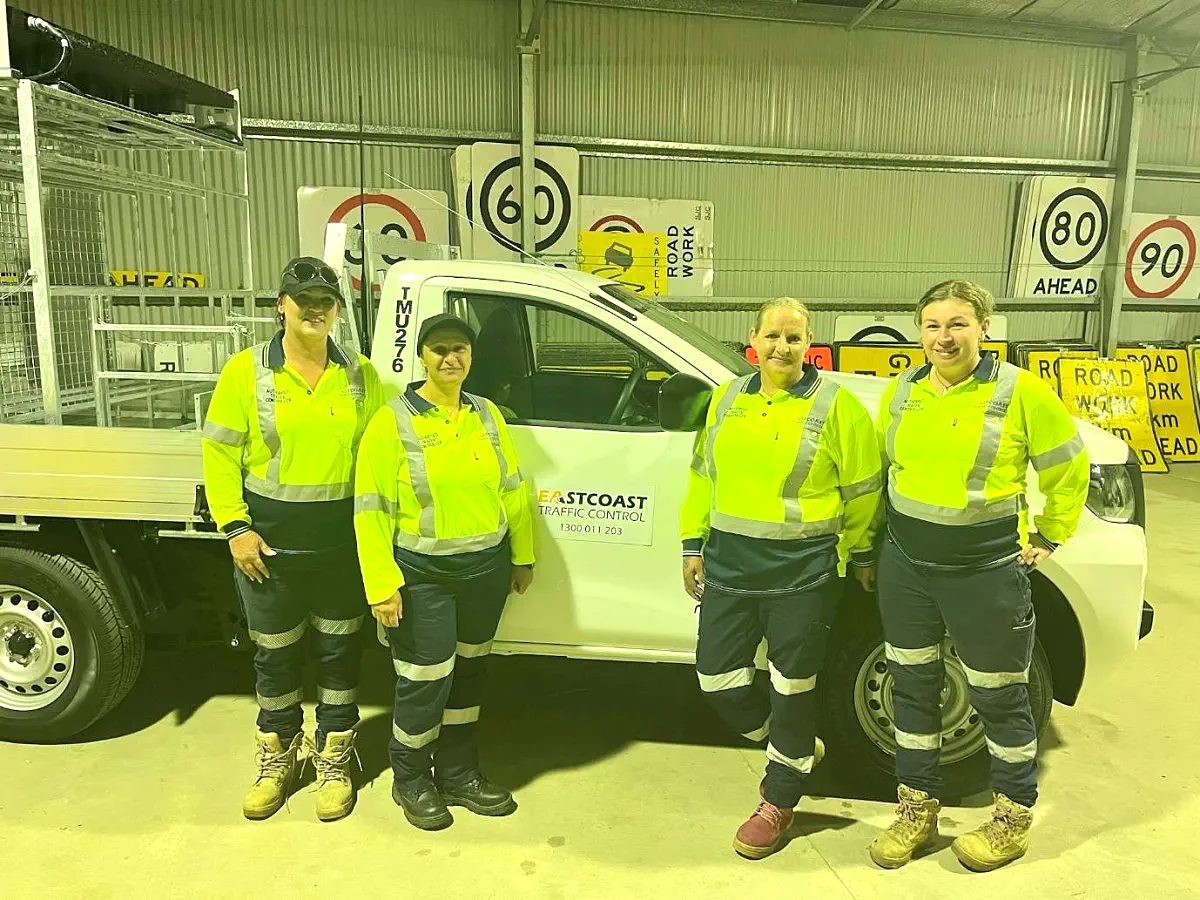
Queensland traffic control licences: how accreditation works
In short: To control traffic in Queensland you must hold a Traffic Controller Industry Authority card issued by Transport and Main Roads after an approved RTO course that includes RIIWHS205E and 20 hours of supervised practical placement. Interstate cards are not transferable. Traffic Management Implementer (TMI) and Traffic Management Designer (TMD) are separate, higher cards. ECTC is not an RTO.
Who needs traffic controller accreditation in Queensland?
Anyone who controls traffic at a road work site or event where a road is fully or partly closed must be accredited by the Department of Transport and Main Roads (TMR) under the Traffic Controller Accreditation Scheme (TCAS). TMR's own words: "Traffic controllers are authorised by the Department of Transport and Main Roads to control traffic at road worksites and other events where a road closure or part road closure is necessary."
TMR lists the exceptions: police officers, escort vehicle drivers, TMR school crossing supervisors, State Emergency Service officers and people directing traffic inside a car park do not need accreditation. Everyone else holding a stop-slow bat on a public road does.
Employers carry the other half of the obligation. Under the Transport Operations (Road Use Management) accreditation regulations an employer must not engage a person as a traffic controller unless they are accredited, and must ensure controllers comply with the conditions of their accreditation. That is why ECTC asks for your card before anything else.
The Queensland traffic controller pathway, step by step
This is the pathway as published by TMR in the Traffic Controller Accreditation Scheme page and the Approved Traffic Controller Training Program information sheet.
Get a general construction induction card (white card)
The RTO must be satisfied you hold a general construction induction card before you start the work site placement. Without it there is no site access and no placement.
Complete the approved course with a TMR-approved RTO
Since 1 July 2010 the approved traffic controller course has only been available through registered training organisations approved by TMR. The package includes the national unit RIIWHS205E Control traffic with a stop-slow bat plus the work safely (RIIWHS201) and workplace communication (RIICOM201) units, delivered in the context of the Queensland MUTCD and TCAS. The off-the-job part is nominally eight to nine hours.
Log 20 hours of supervised practical placement
New entrants must complete a minimum of 20 hours of practical experience at a road work site under the direct supervision of an experienced accredited traffic controller, recorded in a logbook. The RTO arranges the placement with a work site or registered traffic management company. The placement is unpaid, must be insured by the RTO, and the whole program must be finished within three months. QGTTM Part 7 adds that the supervising controller must stand within 3 metres of a trainee using a stop-slow bat in live traffic.
Pass the final on-site assessment
After the logbook is returned, the RTO assesses the logged experience, takes feedback from the host site, and carries out an on-site final assessment before issuing a Statement of Attainment.
Apply to TMR for the Industry Authority card
Lodge the application online or at a transport and motoring service centre with the Statement of Attainment, evidence of identity and the fee. You must have held an open or provisional driver licence within the last five years, and the course must have been completed within the 12 months before you apply. TMR runs offence history, licence history and medical suitability checks; completing the course does not by itself mean the application will be approved.
Carry the card, renew every three years
Accreditation is issued for three years. You must produce the card or interim authority on request from police, transport inspectors, WHSQ inspectors, TMR auditors or the person in charge of the site. Renewal requires currency of industry practice and the approved renewal training through a TMR-approved RTO.
The three Queensland tiers: TC, TMI and TMD
Clause 1.7 of the Queensland MUTCD Part 3 (November 2025) lists the prescribed training courses. These are the three most project managers and job seekers ask about.
| Card | What it authorises | Prescribed training | Issued by |
|---|---|---|---|
| Traffic Controller (TC) | Control traffic with a stop-slow bat in accordance with the approved TGS and the TCAS Approved Procedure; QGTTM Part 7 also covers controlling cyclists and pedestrians on a roadway | TMR approved traffic controller course (RIIWHS205E plus safety and communication units) and 20-hour placement | TMR Traffic Controller Industry Authority card, three years |
| Traffic Management Implementer (TMI) | Read, interpret and implement TMPs and TGSs, install and remove signs and devices, supervise the set-out | TMR approved Traffic Management Implementation course (RIIWHS302E Implement traffic management plan) | TMR Traffic Management Implementation card; renewal required through an approved provider |
| Traffic Management Designer (TMD) | Design, develop, review and inspect TMPs and TGSs to the MUTCD Part 3 and QGTTM | TMR Traffic Management Design course; continuing professional development is required to keep the card; restricted and open qualification levels exist | TMR TMD card; TMR publishes card status and a list of consenting cardholders |
Other roles the MUTCD prescribes training for
Clause 1.7 of the Queensland MUTCD Part 3 goes beyond the three main cards. Working in Proximity to Traffic Awareness Part 1 is required for anyone who works on or adjacent to a road, and Part 2 for workers who select and apply work protection methods under the short-term, low-impact provisions. Both are online TMR programs. Event Traffic Marshal training is required for volunteers doing event traffic management.
Truck-mounted attenuator (TMA) drivers in Queensland must have completed TMI training and then act in accordance with QGTTM Part 8 Table A7. Lookout persons, roadworks pilot vehicle drivers and authorised persons also have specific QGTTM requirements. If a client asks ECTC for a TMA crew, the driver is a TMI holder with TMA-specific training on top. ECTC completed TMA driver licensing for crew members in 2025 and now runs its own attenuator vehicles on high-speed corridors.
ECTC is not an RTO. Here is what we can and cannot do
East Coast Traffic Control does not deliver the course, assess competency or issue cards. Only a TMR-approved registered training organisation can do that. Our traffic control course page lists the RTOs we refer people to across Queensland and NSW, including AATS Training, Link Resources, Global Training Services, DTC Training, All State Training, Traffic Management Training, Advanced Certified Training Australia, SWQ Training, RudTek and Upskills Qld. Contact one in your region; course fees, dates and enrolment are between you and the RTO.
What we can sometimes do is host the 20-hour practical placement. The RTO must arrange the placement with a work site manager or a registered traffic management company, and ECTC crews host trainees when depot workload and supervision capacity allow. That is a decision made job by job, it is unpaid by law, and it does not come with a job at the end. Once you hold your Industry Authority card you apply through our employment page and we place people according to depot demand.
Nobody works on an ECTC site without a current card. There is no training on the job before accreditation, and no stop-slow work on an expired card.
What ECTC checks before a traffic controller starts
- Current TMR Traffic Controller Industry Authority card (or interim authority) with a valid expiry date
- General construction induction card (white card)
- Current driver licence, because regional and remote sites mean travel
- First aid certificate (an ECTC and industry requirement rather than a TMR condition)
- TMI card and currency for anyone who will set out or supervise a TGS
- Compliant high-visibility clothing that meets the TCAS clothing requirements, plus boots, hard hat and eye protection
- Medical fitness to perform the role, which the controller self-assesses throughout the accreditation period under the TCAS Approved Procedure
- Willingness to work the hours the job sets: early starts, nights, weekends and wet weather
Why Queensland also registers the companies
Accreditation covers the individual. The company is covered separately by the TMR Traffic Management Registration Scheme, which has been mandatory for any traffic management company working on state-controlled roads since 1 February 2011. Registration runs for three years and requires certified safety and quality systems, financial stability checks, industrial relations compliance and trained staff. TMR encourages councils to use registered companies even though the scheme does not cover local roads, and a TMR Traffic Control Permit can only be applied for by a registered company.
For a project manager, the practical check is simple: ask for the controller cards, the TMI card for the person running the site, the TMD details for whoever drew the plan, and the company's registration certificate number.
When to bring in ECTC
If you are hiring a crew, you want every person on your site to be accredited for the role they are doing and the company to be registered with TMR for state-controlled road work. ECTC has operated in Queensland since 1993 with depots from Cairns to the Gold Coast, and has traffic controllers, implementers and designers in-house. If you are a job seeker, get your card first through an approved RTO, then talk to the depot nearest you about work. See traffic controller hire for how we resource a job.
Related pages
Sources
- TMR Traffic Controller Accreditation Scheme
- TMR Approved Traffic Controller Training Program information and FAQ (January 2021)
- TMR Traffic Controller Accreditation Scheme Approved Procedure (January 2022)
- TMR Traffic management training (TC, TMI, TMD, Working in Proximity to Traffic)
- TMR Approved Traffic Management Implementation training providers (RIIWHS302E)
- Queensland MUTCD Part 3 clause 1.7 Prescribed training, November 2025
- QGTTM Part 7: Traffic Controllers, November 2025
- TMR Traffic Management Registration Scheme fact sheet
- SafeWork NSW Traffic Control Work Training (Automatic Mutual Recognition excludes Queensland)
Local depots
Common questions
How long does it take to get a traffic controller licence in Queensland?
The classroom part is nominally eight to nine hours, then you need a minimum of 20 hours of supervised placement at a road work site, a final on-site assessment, and TMR's processing of your application. TMR requires the whole training program to be completed within three months and the application lodged within 12 months of finishing the course. Placement availability is usually the slowest step.
Can I work in Queensland on my NSW or Victorian traffic control card?
No. TMR states you are only authorised to control traffic in Queensland if you are accredited in Queensland, and interstate accreditation is not transferable. Queensland is excluded from the Automatic Mutual Recognition scheme that applies elsewhere. An approved RTO may offer a shorter course recognising prior competencies, but you still need a Queensland Industry Authority card before you start.
What is the difference between a TC and a TMI in Queensland?
A Traffic Controller (TC) holds the stop-slow bat and controls traffic at a position shown on the TGS. A Traffic Management Implementer (TMI) holds a higher TMR card, earned through RIIWHS302E, and is responsible for reading the plan, setting out and removing signs and devices, and supervising the site. A TC cannot set out a TGS; a TMI cannot design one.
Does ECTC train traffic controllers or issue tickets?
No. ECTC is not a registered training organisation. Only a TMR-approved RTO can deliver the course and only TMR issues the card. We publish a list of RTOs on our traffic control course page, and when depot capacity allows we host trainees for the 20-hour placement that the RTO arranges. Once you hold your card you can apply to work with us.
Is the 20-hour placement paid?
No. TMR's course information sheet states that trainees undertaking the practical placement are not entitled to be paid for it, and the RTO must hold insurance covering each trainee at no separate charge. The placement is part of the training, not employment. Paid work starts only after TMR issues your Industry Authority card and an employer engages you.
How often does Queensland traffic controller accreditation need renewing?
Every three years. To renew you must show currency of industry practice as a traffic controller and complete the TMR-approved renewal training through an approved RTO, then lodge the renewal with TMR before the expiry date. Traffic control duties must not be performed on an expired card. TMR can email a reminder three days before expiry if you are signed up for e-reminders.
Need crews on site?
Send the job and your local Area Manager takes it from there, day or night.