
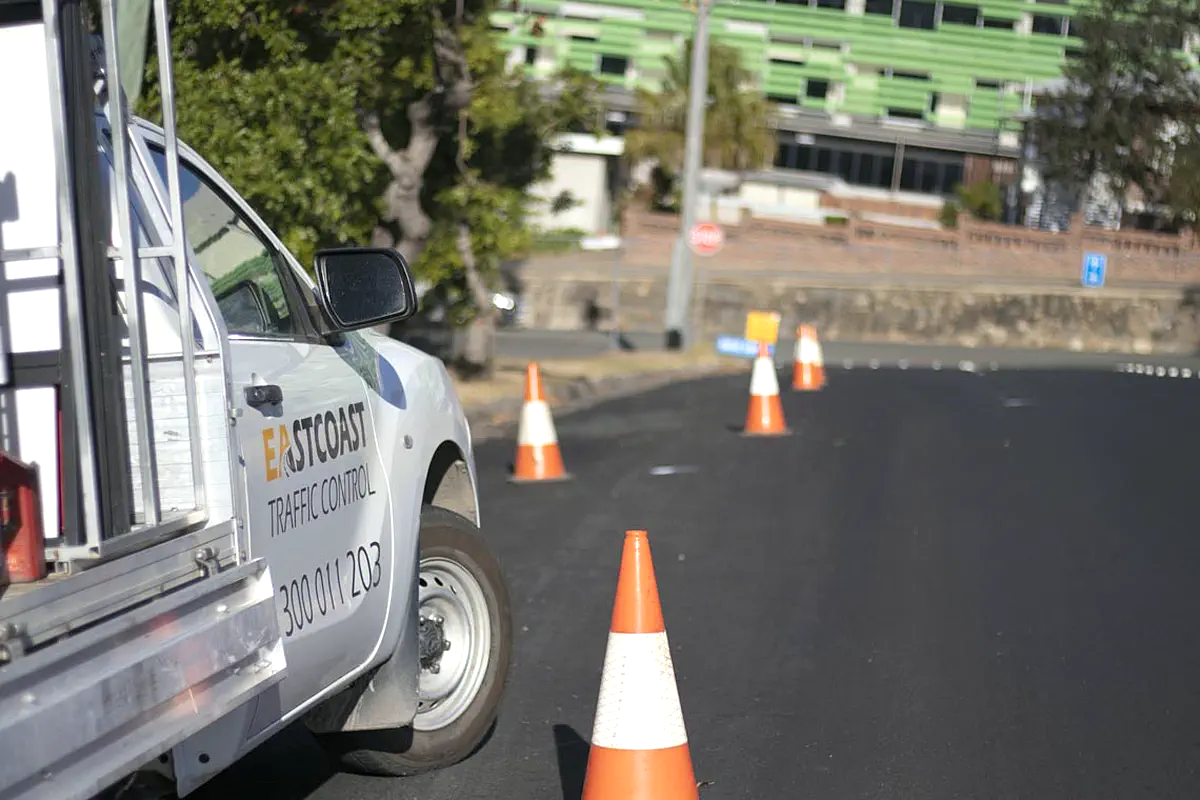
Roadworks and civil traffic control
In short: ECTC supplies roadworks traffic control for civil contractors and road authorities across Queensland and New South Wales: accredited TCs and TMIs, Traffic Guidance Schemes drawn to the posted speed, portable traffic signals, TMA vehicles for high-speed corridors and TMR or council permits lodged for you. Crews mobilise from 13 depots, day or night, for anything from a kerb repair to a 36-hour highway closure.
Who this service is for
Civil contractors, pavement and asphalt companies, head contractors on TMR and TfNSW projects, rail operators working at road interfaces, subdivision developers and the estimators pricing all of the above. If your scope touches a live carriageway, shoulder, footpath or intersection, this is the page.
The jobs range widely. A two-hour pothole patch on a rural council road. A six-month reseal program across a TMR district. A $300 million duplication with multiple live work zones. The standard is the same at every size: a plan that matches the site, a crew accredited for the state, and setups that an auditor can walk without finding a problem.
What is included in roadworks traffic control
You book one scope and get the people, the paperwork and the gear. Crews are a mix of Traffic Controllers (TCs), who direct traffic with the stop/slow bat or PTCD, and Traffic Management Implementers (TMIs), who set out the Traffic Guidance Scheme, supervise the site and sign off compliance. Our Traffic Management Designers (TMDs) prepare the TMP and each TGS to the current TMR or TfNSW edition, and we lodge the permit with the road authority.
- Accredited TCs and TMIs from the nearest depot, scaled to the number of control points
- Traffic Management Plan and site-specific Traffic Guidance Schemes drawn to scale against the posted speed limit
- Permit lodgement and tracking with TMR districts, councils, Queensland Police and TransLink (Queensland)
- Utes with arrow boards, cone deployment trucks, signage packs, bollards and barriers
- Portable Traffic Control Devices: portable traffic signals, remote boom gates and automated stop/slow units for higher-speed or poor-visibility sites
- Variable Message Sign trailers placed ahead of the works and updated remotely when the schedule moves
- Truck Mounted Attenuator vehicles and TMA-accredited drivers for works in 80 km/h and faster zones
- Pre-start, staged setup, site monitoring and end-of-shift documentation
How a roadworks job runs
The same sequence whether the job is a day or a year.
Scope with the Area Manager
Location, works description, day or night, shift length, duration and the layout (shoulder, lane closure, intersection type). The Area Manager confirms crew numbers, vehicles and whether a new TGS or permit is needed.
Design and lodge
A TMD reviews the site, draws the TGS for each phase and writes or updates the TMP. We lodge with the road authority and give you the expected decision date. For the Rockhampton Bruce Highway closure that design work took six weeks of iteration with TMR before the weekend.
Pre-site check and loading
Every site is assessed physically or by mapping: road width, shoulders, sight lines, speed zones, entry and exit points. The depot loads and compliance-checks vehicles, signage, PTCDs, VMS and lighting.
Set out early, in sequence
Crews arrive ahead of the start time. Pre-start covers roles, hazards, radio check and emergency procedures. Advance warning signs go up first, then tapers, then the control point, then pedestrian detours and VMS.
Run, monitor, adjust
The TMI watches the site against the plan, moves signs when visibility changes, updates VMS messaging, rotates controllers for fatigue and escalates anything that drifts from the TGS before it becomes a compliance issue.
Compliance: TMR in Queensland, TfNSW in New South Wales
In Queensland, works on roads follow TMR's Manual of Uniform Traffic Control Devices Part 3 and the Queensland Guide to Temporary Traffic Management. The March 2025 update tightened sign spacing tolerances, made end-of-queue protection mandatory in 80 km/h and faster zones or where visibility is limited, changed multi-message sign rules and detour signage, and requires a documented risk assessment, often with RPEQ certification, for any variation from a 'shall' or 'should' requirement. Our TGS drawings now specify exact distances where tolerances could compound, so the TMI on site is not left guessing.
Work on a state-controlled road needs a TMR permit before the first sign goes out; work on a council road needs that council's works-on-road approval. We lodge both. Queensland Police issue road closure permits for full closures and TransLink is notified when bus routes are affected.
In New South Wales, Transport for NSW's Traffic Control at Work Sites (TCAWS) standard, TS 05492:1.0 since June 2026, governs temporary traffic management on all public roads in NSW, and where it conflicts with AS 1742.3, TCAWS prevails. NSW controllers, implementers and plan preparers hold NSW accreditation; there is no mutual recognition with Queensland and we staff each state accordingly. See MUTCD Part 3 in Queensland and TfNSW traffic control at work sites.
Which plan and permit does a roadworks job need?
Typical requirements. The Area Manager confirms for your site.
| Job | Plan | Permit or approval |
|---|---|---|
| Short works on a council road (patching, kerb repair, service pit) | TGS, often from an existing TMP | Council works-on-road approval |
| Lane closure on a state-controlled road | TMP plus site-specific TGS | TMR district permit |
| Full road closure with detour | TMP, TGS per stage, detour signage plan | TMR or council plus Queensland Police road closure permit; TransLink if buses affected |
| Multi-phase civil project (duplication, intersection upgrade) | Project TMP with a TGS for each phase, reviewed as phases change | Road authority permit per phase or program |
| Works in an 80 km/h or faster zone | TGS with end-of-queue protection and TMA shown | As above; TMA often specified by TMR |
Roadworks and civil jobs we have run
Bruce Highway full closure, Rockhampton, for Queensland Rail: a 36-hour weekend closure of one of the city's primary routes with 22 traffic controllers and 18 utes working day and night in rotation, coordinated with Queensland Police and local taxi operators. The TGS went through six weeks of revision with TMR before the closure went in by mid-afternoon Saturday and the highway reopened late Sunday. Queensland Rail then confirmed ECTC for a larger project in the same area.
Smithfield Bypass Stage 1, Cairns: traffic management for the Highways Constructions and Albem joint venture on the $350 million, 3.8 km bypass of the Captain Cook Highway, including the Yorkeys Knob and McGregor Road intersections. Cairns Western Arterial Road duplication: the $300 million four-lane upgrade between Redlynch Connector Road and the Captain Cook Highway, with duplicated rail overpass and Kamerunga Bridge.
Bruce Highway Cooroy to Curra Section D: large teams across multiple locations for the Bielby-BMD joint venture from late 2020 to October 2024, on a project with 42 bridges at 23 locations. Capricorn and Bruce Highway reseal program: six months of traffic control and planning between Rockhampton and Emerald for Colas Qld. Warrego Highway near Roma: an 8.7 km program with two to three portable signal setups running at a time. Bundaberg-Miriam Vale Road: temporary signals, barriers and speed reductions for RoadTek's intersection realignment at Yandaran, Monday to Friday 6 am to 6 pm.
Spear Creek, Mount Isa: crews from Mackay and Townsville managed a 255 metre dead lane and extended signal distances for bridge inspections and core sampling for CMW Geoscience and TMR inspectors, and the job finished a day early. Toolooa Street, Gladstone: six months supporting Loftus Contracting on a Gladstone Regional Council rehabilitation with a new sewer rising main. Scenic Highway pipeline, Yeppoon: long-running, changing setups for Livingstone Shire Council's water pipeline.
Jobs like this
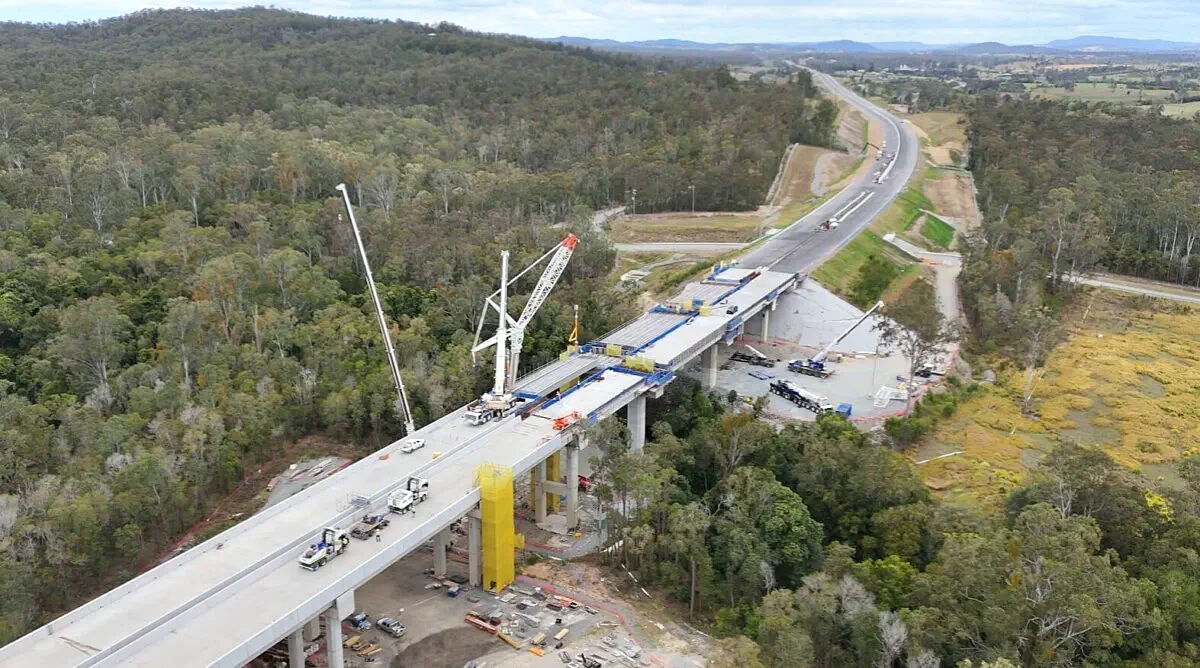 Bruce Highway, Cooroy to Curra Section DBielby-BMD joint venture / Bruce Highway between Cooroy and Curra (Gympie Bypass), QLDRead the job
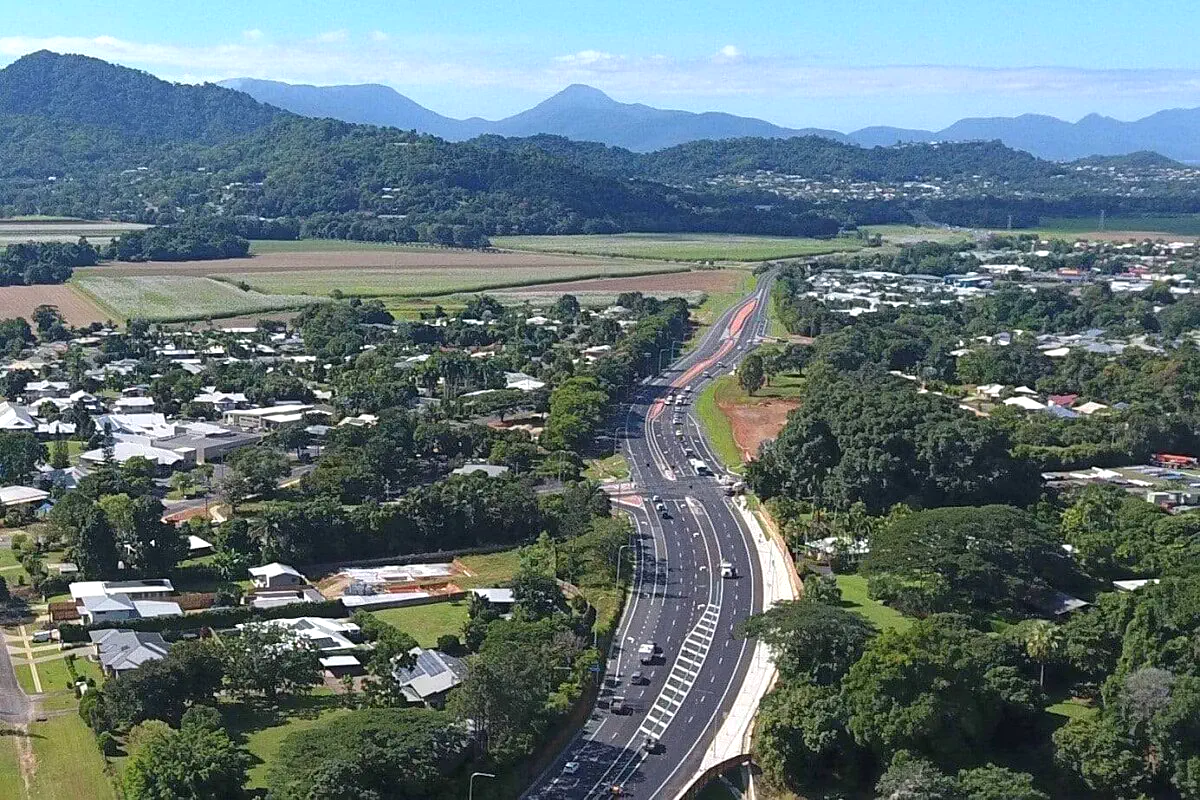 Cairns Western Arterial Road duplication, Redlynch Connector Road to Captain Cook HighwayAlbem Constructions / Cairns Western Arterial Road, Redlynch Connector Road to Captain Cook Highway, Cairns QLDRead the job
Closest depots
Common questions
Do you provide the TGS or do I need to supply it?
Either. Our in-house Traffic Management Designers draw site-specific TGSs and the TMP for your project and we lodge the permit. If you already hold an approved scheme, our TMIs implement it. We will flag it if the scheme does not match the actual site conditions, because that is a compliance failure for both of us.
When is a TMA required on roadworks?
Truck Mounted Attenuators are commonly specified on state-controlled roads where works sit in 80, 100 or 110 km/h zones, and for mobile or short-term works such as line marking and inspections in live traffic. Requirements vary by job and authority. ECTC has TMA-accredited drivers and vehicles, so you do not need a second contractor.
Can you run day and night crews on the same project?
Yes. The Rockhampton Bruce Highway closure ran 36 hours straight with day and night crews in rotation. Fatigue management, crew rotation and lighting are built into the plan. See the night works page for how after-dark setups differ.
How long does a roadworks permit take?
Our permit register shows TMR district permits typically around ten business days from a complete submission, council works-on-road approvals from five to 28 business days depending on the council, and Queensland Police road closure permits around five. We lodge early and give you the estimated decision date so your program holds.
Do you cover remote and regional sites?
Yes. We have worked west to Mount Isa, Normanton and Camooweal, the Warrego Highway near Roma, and the South West Slopes and Riverina in NSW. Crews mobilise from the nearest of 13 depots, with travel and fatigue built into the allocation.
What happens if the works change mid-project?
The TMI on site escalates to the Area Manager and a designer revises the TGS before the new phase starts. A plan written at commencement rarely covers later phases, new plant or a different section of road, so we review the TGS before each phase rather than after an auditor does.
Need crews on site?
Send the job and your local Area Manager takes it from there, day or night.