
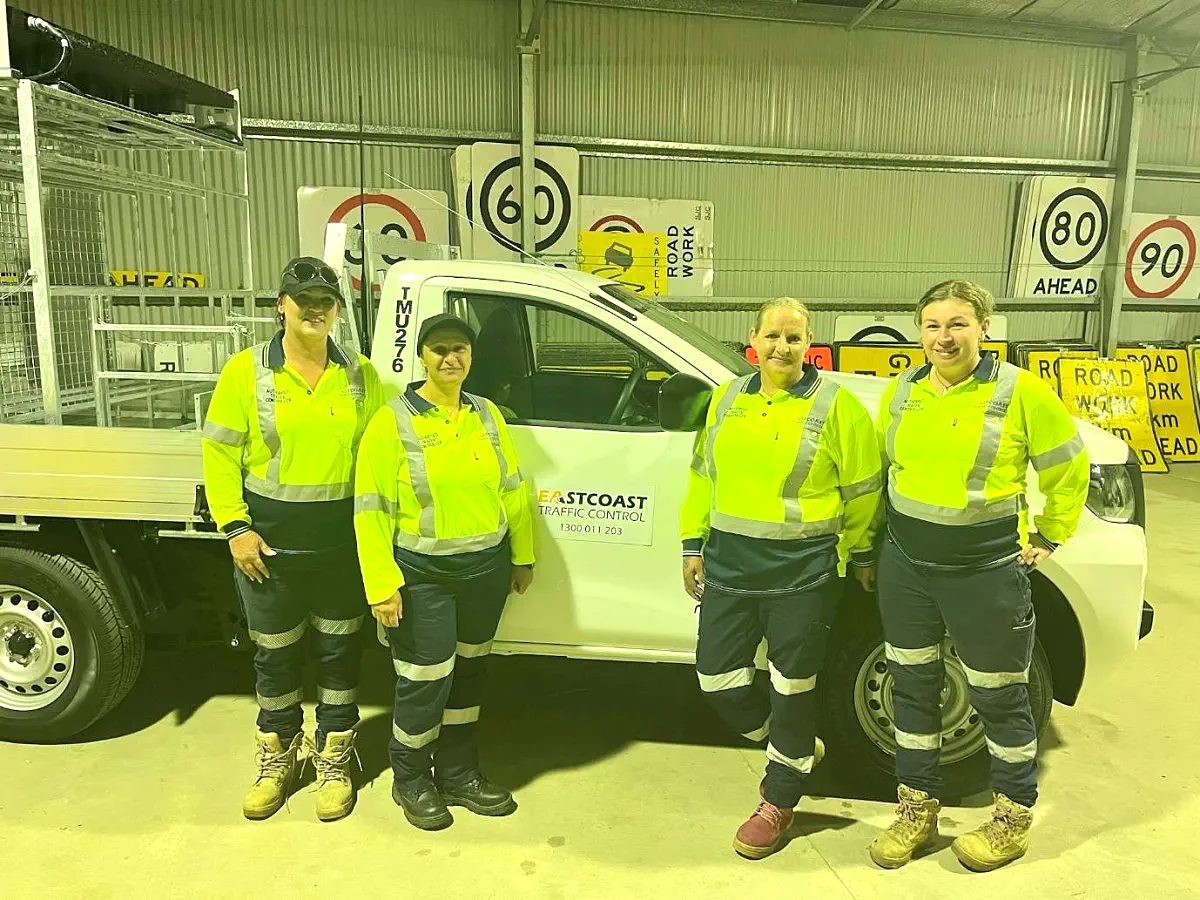
Traffic controller jobs in Queensland and NSW
In short: East Coast Traffic Control employs accredited traffic controllers, Traffic Management Implementers and TMA drivers at 13 depots from Cairns to the Riverina. You need a current traffic controller licence for the state you will work in before applying. ECTC does not deliver training or issue licences.
Who ECTC hires
ECTC employs people who already hold their accreditation and want to work in their own region. We hire locally, which is how we can put people on a flooded causeway or a storm-damaged road quickly. We look for the same things on every job: you turn up on time, you take the setup seriously, you communicate clearly with the crew and the public, and you represent the company well in your own town.
The work is ongoing project work across council programs, state highway upgrades, utility maintenance, events and emergency response. It is physical, outdoors and often early or late. Nights, weekends and travel to remote sites are part of it in most regions. People who are available, reliable and take pride in the setup are the ones we keep calling.
Roles we recruit for across the network: Traffic Controllers (TC and TCR), Traffic Management Implementers (TMI and IMP), Traffic Management Designers (TMD and PWZ) in our planning team, and TMA drivers.
How applying works
There is one form. It goes to the right depot based on your location.
Complete the questionnaire
It asks where you are, which licences you hold and how long you have held them, whether you can travel, your availability and who you have worked for. You can attach a CV but you do not have to.
We check it
Applications are reviewed against the depot's current needs. A current licence for the state you are in and genuine availability are the two things we check first.
Your Area Manager reaches out
If the application is in order and you hold a current licence, the Area Manager for your region contacts you to talk about the work in that area, verify your accreditation and arrange an induction. If there is no work in your area right now, your details stay on file for when there is.
Working from our depots
Each depot is run by a local Area Manager and does the kind of work its region generates. Open a depot to see the area it covers and the manager's contact.
Cairns
Far North Queensland. TMR highway projects such as the Smithfield Bypass and Cairns Western Arterial Road, council works and storm recovery after cyclones.
Townsville
Council roadworks, state highway upgrades and utility work along the Townsville to Cairns corridor, with travel inland to Charters Towers, Ingham, Ayr and Mount Isa.
Mackay
Civil and roadworks around Mackay and the inland mining region, consultant test pits and joint deployments with Townsville to remote bridge and highway jobs.
Rockhampton
Bruce Highway and Rockhampton Ring Road works, reseal programs out to Emerald, Yeppoon council projects, Queensland Rail closures and events across Central Queensland.
Gladstone
Council road rehabilitation, Bruce Highway works at Benaraby and Calliope, port and industrial access and community events in Gladstone.
Hervey Bay
Hervey Bay and Maryborough suburbs plus Burrum Heads, Howard and Tiaro, with emergency works near Maryborough and flood recovery and events up to Bundaberg and Bargara.
Sunshine Coast
One of the busiest depots: lane closures in Brisbane's northern suburbs, Bruce Highway upgrades, the Gympie Bypass, rail corridor works and detours around Gympie and Noosa.
Gold Coast and Northern NSW
Urban developments, transport upgrades, council projects and tourism events, plus hinterland storm recovery and Northern Rivers civil and council works.
Mid North Coast NSW
Coffs Harbour depot covering Grafton council works and flood response, Armidale roadworks, Inverell civil jobs and Kempsey events and minor works.
Dubbo
Council and Transport for NSW road programs across the Central West, including Forbes, Parkes and Bathurst.
Wagga Wagga
Riverina council and state road works, utilities and events, run with the Young and Tumbarumba depots.
Tumbarumba
Snowy Valleys rural and regional road works, with crews shared across the Riverina depots on larger jobs and flood response.
Young
South Western Slopes council works for Hilltops and Weddin, TfNSW heavy patching programs, the Wallendbeen bridge, flood response and events such as concerts in Young.
What the work is like
A traffic controller at ECTC sets up and runs the approved Traffic Guidance Scheme on site: signs, cones, tapers and the stop/slow bat, under a TMI who is responsible for the scheme. Days start early. Night works run on highways and in town centres. In North Queensland the wet season brings flooding and the dry brings heat; in the Riverina it is frost at dawn and 40 degrees by February. Every shift starts with a briefing and a pre-start, and every crew carries radios, lighting and PPE issued from the depot.
Pay is at or above the Building and Construction General On-site Award, with penalty rates for nights, weekends and public holidays. Most regional roles attract a travel allowance, and people willing to travel to remote sites earn more. Crews that stay in the job can move into TMI, TMD, team leader and Area Manager roles.
No licence yet?
Traffic controller accreditation is issued by each state's scheme through approved registered training organisations (RTOs), not by employers. ECTC is not an RTO. In Queensland the course covers three nationally recognised units and a supervised practical placement; in New South Wales the SafeWork NSW cards work differently and are not interchangeable with Queensland's. The training page lists RTOs that deliver the courses and explains what happens after you qualify.
Once you hold a current licence, come back and complete the questionnaire. If you have finished the course and need your 20 hours of practical placement, choose that answer in the questionnaire and it goes to the Area Manager for your area. Placement depends on crew workload, so it cannot be promised.
Ready to apply?
Have your licence details handy. The questionnaire is at the top of this page.
Common questions
Can I apply without a traffic control ticket?
No. If you answer that you do not hold a current licence, the questionnaire sends you to the training page instead of taking your details. ECTC only employs people who hold a current traffic controller licence for the state they will work in, plus a White Card, and does not run courses or issue licences. If you have finished your course and need your 20 hours of practical placement, choose that answer instead. Placement depends on crew workload at the depot, so it cannot be promised.
I have a Victorian or interstate ticket. Can I work for ECTC in Queensland or NSW?
Not on that ticket alone. Traffic controller accreditation is state-based and there is no automatic recognition between states. To work in Queensland you need the TMR Traffic Controller accreditation; in New South Wales you need the Transport for NSW TCR accreditation. An RTO in the state you are moving to can advise what you need to complete.
What happens after I submit the questionnaire?
Your application is reviewed against the current needs of the depot nearest your location. If it is in order and you hold a current licence, the local Area Manager reaches out to talk about the work in that region and verify your accreditation. If there is no work in your area at the moment, your details stay on file.
How many hours will I get?
It depends on the depot and the projects running there, and it changes with the season and the weather. We do not promise a set number of hours. What we can say is that people who are available, reliable and good on site are the first called when work comes in, and that busy regions keep crews on ongoing project work for long stretches.
Do I need my own transport?
For most roles, yes. Crews often start at the depot before dawn or travel direct to regional sites, so you need a licence and a reliable vehicle. The questionnaire asks about transport for Level 1 traffic controllers. Depot utes are used on the job, not for getting to the depot.
Which depot will I work from?
The one nearest your location, which is why the questionnaire asks where you live. Applications are routed to the Area Manager for that region. If you are willing to travel away for work, say so on the form; crews that travel are used on remote highway sealing, flood response and large projects outside their home region.
Need crews on site?
Send the job and your local Area Manager takes it from there, day or night.