
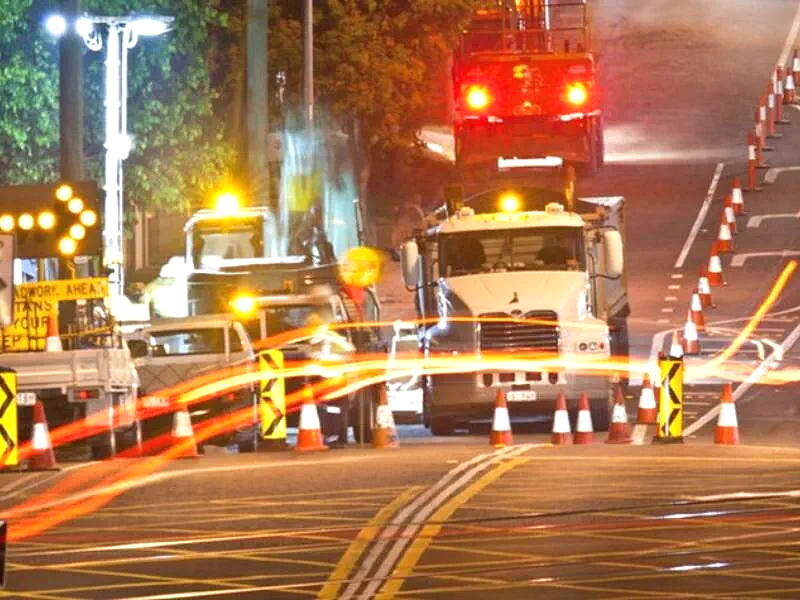
Night works traffic control
In short: ECTC runs night works traffic control across Queensland and New South Wales: floodlit setups with vehicle strobes, portable traffic signals and boom gates so controllers are not standing in a live lane in the dark, fatigue-managed crews on 8, 10 or 12 hour shifts, and staged closures timed to the permit window. Day and night crews ran a 36-hour Bruce Highway closure in Rockhampton in rotation.
Who books night works
Contractors on state-controlled roads where TMR or Transport for NSW will only allow lane closures outside peak hours. Councils doing line marking, reseals and intersection works when the street is quiet. Rail operators working in possession windows. Utilities doing planned outages at night to limit customer impact. Retail precinct works staged overnight so trade is not interrupted. And any 24-hour program that needs a night crew to hand over to a day crew without the setup lapsing.
Night work trades traffic volume for visibility. Fewer vehicles, but every driver who does come through sees less, and so does the crew. The setup has to carry that difference.
What is included in a night setup
- Dedicated night lighting: floodlights on the work area and control points, vehicle-mounted strobes, placed to illuminate hazards without blinding approaching drivers
- Reflective, low-light rated signage, delineation and barrier tape, with sign faces checked for retroreflectivity before the shift
- Portable Traffic Control Devices (portable traffic signals, remote boom gates, automated stop/slow) in preference to a controller in a live lane where the risk calls for it
- VMS trailers deployed on approaches, often days ahead, warning of the night closure window
- TMA vehicles and TMA-accredited drivers for night closures on 80 km/h and faster roads
- Fatigue management: shift lengths, crew rotation, travel limits and on-call Area Manager support
- Staged setup and pack-down timed to the permitted window so the road is back to normal before the morning peak
- Day and night crews for continuous programs, with a documented handover at each change
How a night shift runs
Window and permit
The Area Manager confirms the permitted hours with the road authority or council. Night windows on state-controlled roads are set in the permit; the TGS shows the staging for setup, works and pack-down inside them.
Crew and gear allocation
Controllers and a TMI with night experience, allocated with travel and fatigue in mind. The depot loads lighting, PTCDs, reflective signage, VMS and radios and checks every unit before it leaves.
Set out at dusk, in sequence
Arrive early, pre-start with the client's night supervisor, lighting positioned first so the crew can see to work, then advance warning signs, tapers, control point and pedestrian provisions. Lane closure only when the window opens.
Monitor, rotate, pack down
The TMI watches sight lines as conditions change, updates VMS, rotates controllers on long shifts, and begins pack-down early enough to clear the road before the permit window closes.
Compliance for night works
In Queensland, night setups follow TMR's Manual of Uniform Traffic Control Devices Part 3 and the Queensland Guide to Temporary Traffic Management, which cover illumination of work areas and control points, retroreflective devices and the use of portable traffic control devices. The March 2025 update also requires end-of-queue protection wherever visibility is limited, which at night covers most sites in 80 km/h and faster zones. Permits from the TMR district or the council set the allowed hours; full closures need a Queensland Police road closure permit.
In New South Wales, Transport for NSW's Traffic Control at Work Sites (TCAWS) standard, TS 05492:1.0 since June 2026, governs night work on all public roads, including requirements for lighting, low visibility work and portable variable speed limit signs. NSW crews hold NSW accreditation. We prepare the TGS to the state's current edition and lodge the permit with the hours requested. See MUTCD Part 3 in Queensland and TfNSW traffic control at work sites.
Night versus day: what changes in the setup
| Factor | Day | Night |
|---|---|---|
| Traffic volume | Peak periods, more congestion and queue risk | Lower volumes, higher speeds from some drivers |
| Visibility | Natural light, glare at low sun angles | Lighting required on work area and control points; retroreflective devices |
| Controller exposure | Stop/slow in the lane is common | PTCDs preferred where risk allows; TMA on high-speed roads |
| Pedestrians and cyclists | Higher numbers, especially in town | Fewer, but harder to see; lit detours and crossings |
| Crew | Standard shifts | Fatigue plan, rotation, travel limits, on-call support |
| Window | Often restricted on busy roads | Set by permit, with pack-down before the morning peak |
Night work we have done
Bruce Highway closure, Rockhampton, for Queensland Rail: 36 hours continuous with day and night crews in rotation, 22 controllers and 18 utes, closure in by mid-afternoon Saturday and the highway reopened late Sunday night. Century Cranes has relied on ECTC for crews at all hours of the day and night for many years, in their general manager's words. Council line marking at 3 am is a regular part of our council programs. Retail precinct reseals staged overnight to protect Saturday trade.
Cyclone and flood response is night work by default: closures held through the night with lighting and strobes while water levels change, as our crews did across the South West Slopes of NSW in 2022 and in North Queensland in February 2025.
Crew welfare at night
Night crews are allocated with travel distance and fatigue in mind, rotated on long shifts, and supported by an on-call Area Manager and operations staff through the night. Fatigue, cold, wildlife on rural roads and reduced visibility are all in the pre-start. A crew that is alert at 4 am is the one that notices the driver who did not see the signs.
Closest depots
Common questions
Do you charge more for night works?
Night shifts are priced differently from day shifts because of penalty rates, lighting and PTCD equipment, and TMA where required. The scoping form asks day or night and shift length so the quote reflects it. Send the site, hours and layout and the Area Manager will price it. Our cost guide explains the drivers.
Can you run day and night crews on the same job?
Yes. Continuous programs run with a documented handover at each crew change so the setup never lapses. The Rockhampton Bruce Highway closure ran 36 hours straight this way. The TMI on each shift signs in against the scheme and notes any changes made overnight.
What lighting do you provide for night traffic control?
Floodlighting for the work area and control points, vehicle-mounted strobes and warning lights, and retroreflective signage and delineation rated for low light. Lighting is positioned to show hazards without dazzling approaching drivers, and it is checked at the depot before the shift.
Who sets the night work hours?
The road authority or council, through the permit. On state-controlled roads TMR or Transport for NSW set the window to avoid peaks; councils set hours for local roads and often add noise conditions. We request the hours in the permit application and plan the setup and pack-down inside them.
Are portable traffic signals used at night?
Yes, where the risk assessment calls for it. Portable traffic signals and remote boom gates remove the controller from the live lane, which matters most at night and on higher-speed roads. The TGS shows where PTCDs replace stop/slow and the crew still monitors the site.
Need crews on site?
Send the job and your local Area Manager takes it from there, day or night.