
TMP vs TGS: what is the difference, and which one does your job need?
In short: A traffic management plan (TMP) describes how a whole job manages traffic, pedestrians and risk. A traffic guidance scheme (TGS) is the site drawing showing where each sign, device and controller goes. In NSW the older term traffic control plan (TCP) is still used for that drawing. Both states require a trained designer to prepare them.
What is a traffic management plan?
A traffic management plan (TMP) is the document that explains how traffic, pedestrians, cyclists and emergency vehicles will be managed for the whole of a job. It covers the scope and staging of the work, the risk assessment, the road authority approvals, the roles on site, the hours of work, contingency arrangements and the communication plan. The individual site drawings sit inside it.
In Queensland the preparation of a TMP is covered by Section 2 of the Queensland Manual of Uniform Traffic Control Devices (MUTCD) Part 3, Traffic control for works on roads (Transport and Main Roads, November 2025), read together with AS 1742.3-2019 and the Queensland Guide to Temporary Traffic Management (QGTTM) Part 2, Traffic Management Planning. In New South Wales the content of a TMP is set out in Section 10.5 of Transport for NSW Technical Standard TS 05492:1.0 Traffic Control at Work Sites (TCAWS), published 25 June 2026, which lists mandatory and recommended content and explains how component plans relate to the TMP.
Safe Work Australia's Traffic management: guide for construction work (April 2021) adds the work health and safety angle: the person conducting the business or undertaking (PCBU) must manage traffic risks, and for construction work on or near a public road should contact the relevant road authority for its traffic management requirements. Work on or adjacent to a road is high risk construction work, so a safe work method statement is also required.
What is a traffic guidance scheme?
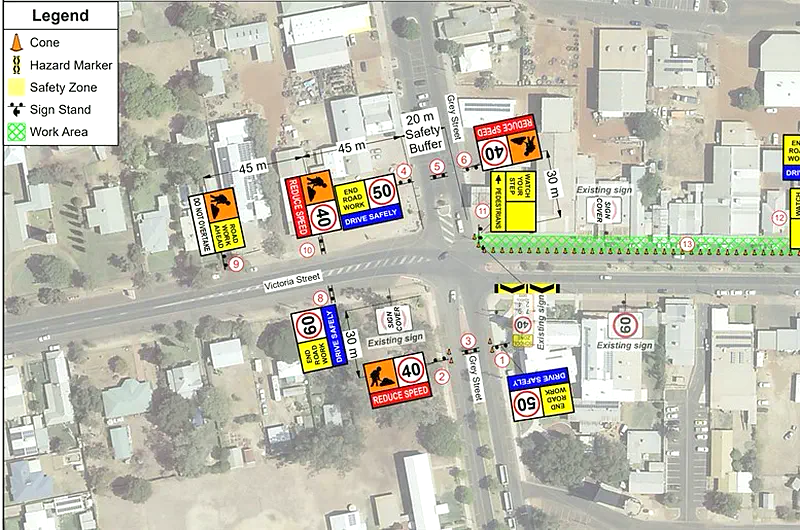
A traffic guidance scheme (TGS) is the drawing, usually one or two pages, that shows the physical layout for a specific work activity: advance warning signs and their spacing, tapers, buffers, cones or barriers, the position of each traffic controller, pedestrian and cyclist paths, speed zone signs and the termination signs. It is what the crew sets out on the day and what an auditor checks against.
In Queensland, Section 3 of the Queensland MUTCD Part 3 deals with the preparation and implementation of traffic guidance schemes, with design detail in QGTTM Part 3 (static worksites), Part 4 (mobile works) and Part 5 (short term low impact worksites). Transport and Main Roads also publishes Technical Note TN195, Traffic Guidance Scheme worked examples, which shows TGS development for different road and work types.
In NSW, TCAWS treats the TGS as one of the component plans of a TMP. Transport for NSW publishes a traffic guidance scheme verification checklist (TCAWS INS-01) that the implementer uses to confirm the scheme on the ground matches the drawing.
One job can need several schemes. A reseal that moves along a road over three weeks may have one TMP and a different TGS for each stage, lane arrangement or intersection.
Where does the term traffic control plan (TCP) fit?
Traffic control plan is the older NSW name for the site drawing. It still appears in official NSW documents. The Transport for NSW Road Occupancy Manual says a traffic control plan must be submitted with every Road Occupancy Licence application, and the NSW Work Health and Safety Regulation 2025 defines the SafeWork NSW training classes as "implement traffic control plans" (IMP) and "prepare a work zone traffic management plan" (PWZ). In practice, when a NSW council or the Transport Management Centre asks for a TCP, they want what TCAWS now calls a TGS.
Queensland does not use the term traffic control plan for the drawing. Confusingly, Transport and Main Roads uses "Traffic Control Permit" (also abbreviated TCP) for the permit a registered traffic management company must hold to close lanes on a state-controlled road. If a Queensland contact says TCP, they almost always mean the permit, not the drawing.
TMP, TGS and TCP compared
The names change at the border, but the jobs each document does are the same.
| Traffic management plan (TMP) | Traffic guidance scheme (TGS) | Traffic control plan (TCP) | |
|---|---|---|---|
| What it is | Whole-of-job management document: scope, staging, risk assessment, approvals, roles, hours, contingencies, communication | Site drawing for one work activity: sign spacing, tapers, devices, controller positions, pedestrian paths, speed zones | Older NSW term for the site drawing; in QLD, TCP means a TMR Traffic Control Permit |
| Queensland reference | Queensland MUTCD Part 3 Section 2, QGTTM Part 2 | Queensland MUTCD Part 3 Section 3, QGTTM Parts 3, 4 and 5, TN195 worked examples | Not used for drawings. TMR Traffic Control Permit for lane closures on state-controlled roads |
| NSW reference | TCAWS TS 05492:1.0 Section 10.5, TfNSW template TCAWS TMP-01 | TCAWS component plan, TfNSW checklist TCAWS INS-01 | Road Occupancy Manual (must accompany every ROL application), WHS Regulation 2025 class names |
| Who prepares it | QLD: a TMR-authorised Traffic Management Designer (TMD). NSW: a holder of the SafeWork NSW PWZ class | QLD: TMD. NSW: PWZ holder | NSW: PWZ holder (formerly the RMS Select/Modify TCP certificate) |
| Who sets it out | QLD: Traffic Management Implementer (TMI). NSW: IMP card holder | QLD: TMI. NSW: IMP card holder | NSW: IMP card holder |
| When it is needed | Any job that changes how a public road operates; larger, staged or state-road jobs always need one | Every work site where signs or devices are placed on or beside a road, including short term work | Every NSW ROL application and most council road reserve consents |
| Who approves or accepts it | QLD: TMR district or council as a permit condition. NSW: council under Roads Act s138, TfNSW for classified roads, TMC issues the ROL | Reviewed with the TMP; QLD councils often ask for the TGS alone for small council-road jobs | NSW TMC does not approve TCPs; it checks one was prepared by a qualified person |
Who is allowed to prepare each document?
Queensland is explicit. Clause 1.7 of the Queensland MUTCD Part 3 (November 2025) lists the prescribed training courses and says traffic management design (TMD) training is "required for persons that design, develop, review and inspect TMPs and TGSs", while traffic management implementation (TMI) training is required for the people who implement them. Clause 1.3.2 adds that competent persons must be authorised by Transport and Main Roads to perform that task in Queensland. TMR keeps a public list of TMD card numbers and their status.
New South Wales ties the roles to the SafeWork NSW Traffic Control Work Training card. The PWZ class covers "design (including vary) or inspect a work zone traffic management plan", which SafeWork NSW describes as preliminary risk assessment plus selecting, modifying and designing traffic management plans and traffic guidance schemes. The IMP class covers implementing the plan at the workplace and does not allow the holder to modify it. Our NSW traffic control licences guide and Queensland traffic control licences guide walk through both schemes.
How a plan becomes a permit and then a crew on site
ECTC's planning team follows the same sequence on every job, whichever state it is in.
Scope the job
We need the location, the dates and hours, the work method, the plant involved, the posted speed limit, the road type and the authority that owns the road. A site visit or desktop review follows for anything beyond a simple shoulder closure.
Design the TMP and each TGS
A TMD (QLD) or PWZ holder (NSW) prepares the plan to the Queensland MUTCD Part 3 and QGTTM, or to TCAWS. Variations from a "shall" requirement in Queensland need a documented risk assessment and, in many cases, RPEQ certification.
Lodge the applications
QLD state-controlled roads need a TMR Traffic Control Permit (TMR asks for at least 10 business days). QLD council roads need a works-on-council-road permit, and road closures need a QPS permit. NSW needs Roads Act s138 consent and, where traffic flow is affected on a state road, a Road Occupancy Licence (minimum 10 working days).
Brief and set out
The TMI or IMP holder reads the approved TGS, sets out the site, verifies it against the drawing and records the check. Traffic controllers then take their positions.
Monitor, adjust, close out
Conditions change. The implementer adjusts within the plan, escalates anything outside it, and records daily inspections. Signs come down in the reverse order and the authority is notified when the road is clear.
How long should you allow?
Design time depends on complexity, but the permit clock is the part most people underestimate. From ECTC's own permit register across Queensland, our planning allowance is 10 business days for a TMR Traffic Control Permit in every district we work in, 5 business days for a Queensland Police Service road closure permit, and between 5 and 28 business days for a works-on-council-road permit depending on the council. In NSW the Road Occupancy Manual states that proponents must allow a minimum of 10 working days for an ROL, and Transport for NSW asks for 10 to 15 working days to review a works-in-the-road-reserve proposal.
Those clocks start when the application is complete, which means the TMP and TGS have to be finished first. Start the plan as soon as the scope is firm. Our permits and road occupancy page covers the applications in more detail.
When to bring in ECTC
If your job touches a public road in Queensland or New South Wales, you will need at least a TGS and usually a TMP, and the person who prepares them must hold the right authorisation for that state. ECTC has prepared plans and run crews in Queensland since 1993 and NSW since 2022, with in-house designers and implementers, so the plan that goes to the council or road authority is the same plan our crew sets out. Send us the location, dates, hours, work method and speed limit and we will tell you which documents and permits the job needs.
Related planning pages
Sources
- Queensland MUTCD Part 3: Traffic control for works on roads, Transport and Main Roads, November 2025
- Queensland Guide to Temporary Traffic Management Part 1, Transport and Main Roads, November 2025
- TfNSW Technical Standard TS 05492:1.0 Traffic Control at Work Sites (TCAWS), published 25 June 2026
- TfNSW temporary traffic management templates and checklists (TCAWS TMP-01, INS-01)
- TfNSW Road Occupancy Manual
- TfNSW Works in the road reserve (Roads Act 1993 s138 consent)
- TMR Traffic control permit
- SafeWork NSW Traffic Control Work Training
- Safe Work Australia, Traffic management: guide for construction work, April 2021
Local depots
Common questions
Do I need a TMP or just a TGS for a small job?
Every site where signs or devices go on or beside a road needs a TGS. Whether you also need a full TMP depends on the road authority and the job. Queensland councils often accept a TGS alone for short council-road works, while state-controlled roads and NSW Road Occupancy Licences expect a TMP with the drawing attached. Ask the authority early rather than assume.
Is a traffic control plan the same as a traffic guidance scheme?
In NSW, yes in practice. Traffic control plan (TCP) is the older term for the site drawing that TCAWS now calls a traffic guidance scheme, and NSW documents such as the Road Occupancy Manual still use TCP. In Queensland, TCP means a Transport and Main Roads Traffic Control Permit, which is a permit, not a drawing.
Can a traffic controller prepare a TGS?
No. In Queensland the MUTCD Part 3 reserves design, review and inspection of TMPs and TGSs for people who hold traffic management design (TMD) authorisation from Transport and Main Roads. In NSW the SafeWork NSW PWZ class is required to design or vary a plan. A traffic controller or implementer card does not cover design work in either state.
Does the road authority approve the TGS?
It depends on the authority. Queensland districts and councils review the TMP and TGS as part of the permit application. In NSW the Transport Management Centre states that it does not approve traffic control plans; it requires one to be submitted with every Road Occupancy Licence application and checks it was prepared by a qualified person, while councils review plans under their Roads Act consent process.
How far ahead should I start the plan?
Work backwards from the permit lead times. ECTC's permit register allows 10 business days for a TMR Traffic Control Permit, 5 for a Queensland Police road closure permit and 5 to 28 business days for council permits depending on the council. NSW Road Occupancy Licences need at least 10 working days. The plan must be finished before any of those clocks start.
What happens if the site does not match the TGS?
The implementer must either bring the site back to the drawing or stop and have the designer revise the scheme. In Queensland, any variation from a "shall" requirement needs a documented risk assessment and often RPEQ certification. Auditors from TMR, Transport for NSW and councils compare the site to the approved drawing, and a mismatch can stop the job.
Need crews on site?
Send the job and your local Area Manager takes it from there, day or night.