
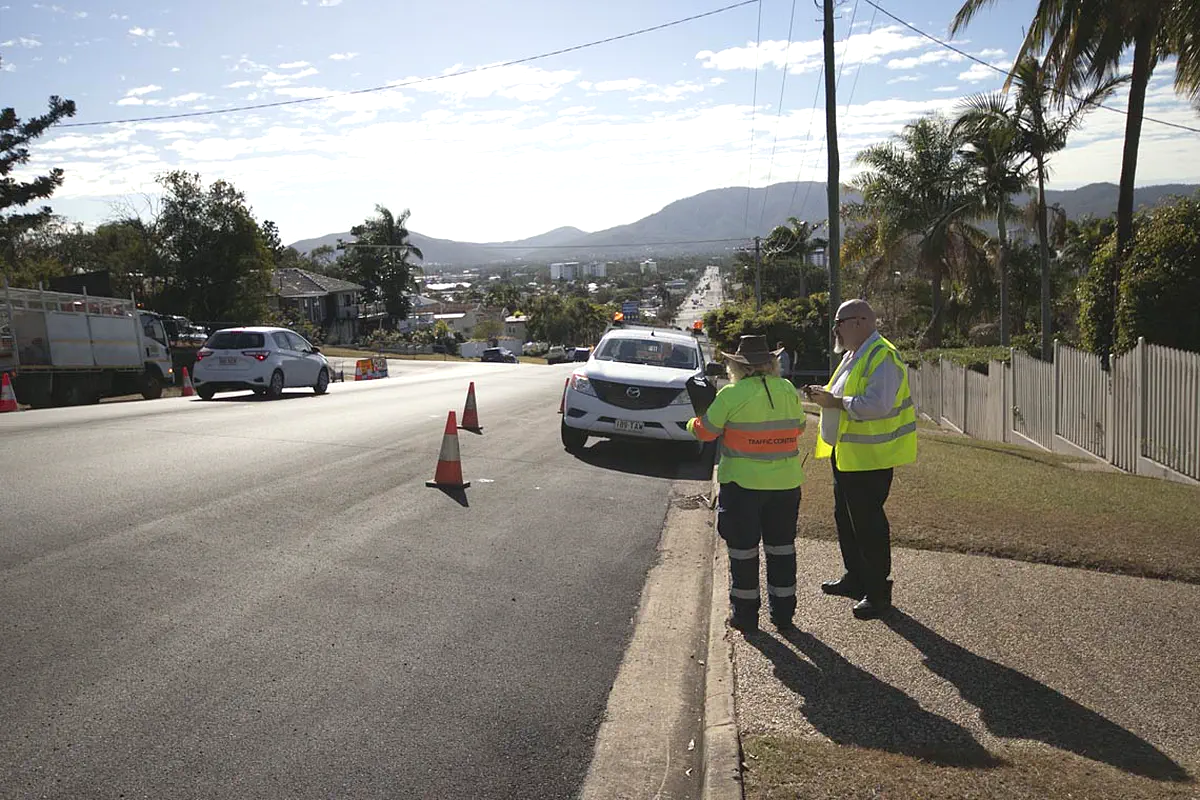
Traffic Control at Work Sites (TCAWS): what the NSW standard requires
In short: Traffic Control at Work Sites (TCAWS) is Transport for NSW's standard for temporary traffic management. Technical Standard TS 05492:1.0, published 25 June 2026, replaced the Issue 6.1 Technical Manual and sets minimum requirements for all public roads in NSW. From 1 July 2026 the Roads Act requires road work speed limit signs to follow it; councils apply it through their authorisation.
What is TCAWS?
Traffic Control at Work Sites (TCAWS) is the Transport for NSW document that sets out how temporary traffic management must be planned, implemented, inspected and reviewed in New South Wales. Transport for NSW published it as Technical Standard TS 05492:1.0 on 25 June 2026. In TfNSW's words it "specifies the minimum technical requirements and provides comprehensive guidance for temporary traffic management on all public roads in NSW" and its purpose is "to ensure the safety on work sites and other activities requiring temporary traffic management on or near roads and for the safe and efficient movement of traffic, including cyclists, pedestrians and other road users."
Before June 2026 the document was the TCAWS Technical Manual Issue 6.1 (February 2022), amended by Technical Directions TD 00031:2022 and TD 00003:2022. Issue 6.1 described itself as applying to Transport for NSW construction and maintenance work sites. The new standard is explicit that it is the primary reference for all public roads in the state, which closes the old argument about whether a council street was covered.
TCAWS sits alongside the Australian Standard AS 1742.3 and the Austroads Guide to Temporary Traffic Management (AGTTM). TfNSW says its temporary traffic management team works on "harmonising NSW practices with AS 1742.3 and Austroads guidance where possible", and Section 2 of the standard clarifies how those documents are used. Where TCAWS states a requirement, TCAWS governs in NSW.
Why the June 2026 change matters legally
Two things gave the standard teeth. First, from 1 July 2026 Section 77A of the Roads Act 1993 requires road authorities, and persons acting under a road authority approval, to install, maintain and remove road work speed limit signs in accordance with TCAWS (NSW Government Gazette No 254 of 26 June 2026, item 5). Second, compliance with the standard is a condition of the Prescribed Traffic Control Devices and Regulation of Traffic Instrument of Authorisation and Delegation issued to councils, which covers the use of portable traffic control lights and road work speed limit signs.
In plain terms: if your job puts up a temporary speed limit sign or a set of portable traffic signals anywhere in NSW, the way you do it is now a statutory requirement, not just a TfNSW contract condition.
What TS 05492:1.0 changed from Issue 6.1
From the TfNSW fact sheet published with the standard (June 2026). Refer to the standard itself for the full text.
| Section | Change |
|---|---|
| 1 and 2: Scope and application | Applies to activities and works on all public roads in NSW; exemptions and exclusions stated more clearly; clarifies use of Australian Standards and Austroads Guides |
| 5: Health and safety | Clarifies the roles of TfNSW and a PCBU in managing TTM risks under the Work Health and Safety Regulation 2025; lists safety specifications for TfNSW projects |
| 7: Departures | A structured process for concessions and departures from the standard, with documented rationale |
| 9.4 and 9.5: Vehicles and personnel | All vehicles, plant and equipment must carry the organisation's name or logo; SafeWork NSW training requirements, worker roles and legal obligations, the NSW position on the Austroads national training framework, and fatigue risk management for TTM workers |
| 9.7 and 9.8: Devices and approvals | Approval to use prescribed traffic control devices; role of the Austroads Safety Barrier Assessment Panel and the AITDSA scheme for innovative devices; specific approval requirements for TfNSW road occupancy, speed zone authorisation and council approvals |
| 10.5: Traffic management plan | Lists mandatory and recommended TMP content and describes the component plans (including the traffic guidance scheme) and their purpose |
| 11.1 to 11.5: Inputs to the TMP | Introduces short term low impact work; new minimum lane widths; updated tables of controls for protecting a work area |
| 11.6: Specific users | New requirements for cyclists, e-bikes and micro-mobility, heavy vehicle movements to and from the site, and works near bus stops |
| 11.7: Temporary speed zones | Speed management at non-active sites; more signage options including multiple, offset or localised speed zones and frequently moving work |
| 11.8 and 11.9: End of queue | Guidance on estimating queue lengths and new mandatory measures for reducing end-of-queue collisions based on risk rating and location |
| 12: Providing for works | TTM during special events, rolling blocks, low visibility and night work; new requirements for portable traffic control devices near permanent signals and in place of stop-slow bats |
What TCAWS requires of a traffic management plan
Section 10.5 lists the mandatory and recommended content of a TMP. A TMP under TCAWS details the work, identifies the risks and the accepted controls, and includes component plans. Transport for NSW's templates page describes the supporting documents: a traffic management strategy (TMS) prepared during project development for larger jobs, the traffic guidance scheme (TGS) showing the site layout, and a vehicle movement plan (VMP) for how works traffic enters, moves around and leaves the site.
The implementer then verifies the TGS on site, inspects the site each shift and each week, and inspects again after completion. TfNSW publishes checklists for each of those steps (TCAWS INS-01 to INS-04) plus a checklist for portable VMS and variable speed limit sign placement. Site supervisors on TfNSW projects use a separate surveillance checklist. At the time of review TfNSW's templates were still based on Issue 6.1 and carry a notice that they must be validated against TS 05492:1.0 until the updated versions are released.
How TfNSW, the TMC and councils apply it
On Transport for NSW's own construction and maintenance contracts, TCAWS is enforced through the TS 03401 (G10) Temporary Traffic Management specifications (QA, design and construct, and maintenance versions), which were comprehensively updated with effect from 22 January 2026.
On any state road, work that is likely to impact traffic flow needs a Road Occupancy Licence from the Transport Management Centre, applied for through the OPLINC system. The Road Occupancy Manual requires a traffic control plan with every application, states that the TMC does not approve the plan but checks it was prepared by a qualified person, and tells proponents to allow a minimum of 10 working days for processing. Restricted periods apply around school and public holidays. Works affecting a bus route need written agreement from the bus operator.
On council roads, Section 138 of the Roads Act 1993 makes the council the consenting authority for works in the road reserve, with TfNSW concurrence on classified roads. Councils apply TCAWS through their consent conditions and through the council authorisation instrument described above. A Road Occupancy Licence is also needed where works impact traffic on a state road or are within 100 metres of traffic lights. Our permits and road occupancy page covers the applications.
Applying TCAWS to a job: the sequence ECTC follows
Confirm the road authority
Classified state road, regional road or local road decides whether TfNSW, the TMC, the council or all three are involved. TfNSW publishes the schedule of classified roads.
Prepare the TMP and TGS to TS 05492:1.0
A PWZ holder designs to the current standard, including the new lane width, end-of-queue, speed zone and cyclist provisions, and documents any departure through the Section 7 process.
Lodge consent and ROL applications
Section 138 consent to the council (allow the council's lead time, and 10 to 15 working days for TfNSW review of works in a classified road reserve), and the ROL through OPLINC with the TCP attached (minimum 10 working days).
Set out and verify
An IMP holder sets out the TGS, completes the verification checklist and keeps shift and weekly inspection records. Controllers hold their positions under the plan.
Notify, operate, close out
The licensee's on-site representative contacts the TMC Transport Operations Room before closing a lane on a state road and again when the road is clear. Post-completion inspection closes the record.
When to bring in ECTC
If your job is on a NSW road, your plan has to meet TS 05492:1.0, your people have to hold the right SafeWork NSW classes, and someone has to manage the council consent and the ROL. ECTC has run NSW work from the Young depot since late 2022 and from the Mid North Coast depot since mid 2025, with PWZ designers and IMP implementers in-house and TMA crews for high-speed corridors. Send us the road, dates and scope and we will tell you what the standard requires for it. See roadworks and civil and our Mid North Coast page.
Related pages
Sources
- Transport for NSW: Traffic Control at Work Sites Standard TS 05492:1.0
- TfNSW fact sheet: TS 05492:1.0 TCAWS publication update, June 2026
- TfNSW Temporary Traffic Management
- TfNSW temporary traffic management templates, checklists and example documents
- TfNSW Road occupancy licences
- TfNSW Road Occupancy Manual
- TfNSW Works in the road reserve (Roads Act 1993 s138)
- TfNSW Traffic Control Work Training
- TfNSW TCAWS 6.1 fact sheet (superseded edition, for history)
Local depots
Common questions
Is TCAWS a manual or a standard?
Since 25 June 2026 it is a standard: Transport for NSW Technical Standard TS 05492:1.0 Traffic Control at Work Sites. It replaced the TCAWS Technical Manual Issue 6.1 (February 2022) and its two technical directions. The reclassification aligned it with the TfNSW Standards Management Framework and made the mandatory requirements easier to identify.
Does TCAWS apply to council roads in NSW?
Yes. TS 05492:1.0 states it applies to temporary traffic management on all public roads in NSW. Councils are also bound through the TfNSW Instrument of Authorisation and Delegation, which makes compliance with TCAWS a condition of using portable traffic signals and road work speed limit signs, and through Section 77A of the Roads Act from 1 July 2026.
Do I need a Road Occupancy Licence for every NSW job?
No. An ROL is required for any activity likely to impact traffic flow on a state road, including work within 100 metres of traffic lights, and is applied for through OPLINC with a traffic control plan attached. Local road works need council consent under Section 138 of the Roads Act instead, with TfNSW concurrence on classified roads.
How much notice does the Transport Management Centre need?
The Road Occupancy Manual says proponents must allow a minimum of 10 working days from receipt of a complete application. Transport for NSW separately asks for 10 to 15 working days to review a works-in-the-road-reserve proposal on a classified road. Restricted periods around school and public holidays block planned work on listed roads altogether.
Who can prepare a TMP under TCAWS?
A person who holds the SafeWork NSW Prepare a work zone traffic management plan (PWZ) class. TCAWS Section 9.5 sets out the roles, and the WHS Regulation 2025 requires the PCBU to confirm the person trained or practised in that class within the last two years. The Road Occupancy Manual also requires the plan to be endorsed by a qualified person with their certificate number.
Are the TfNSW templates up to date with the new standard?
Not yet at the time of review. Transport for NSW's templates and checklists page says the documents are based on TCAWS 6.1, which is superseded, and that all content should be validated against TS 05492:1.0 before use. Updated versions will be announced through the In the Zone newsletter. ECTC checks every template against the standard before using it.
Need crews on site?
Send the job and your local Area Manager takes it from there, day or night.