
How much does traffic control cost? The drivers behind every quote
In short: Traffic control is priced from the number of accredited people on site, the hours they work and when (nights, weekends and public holidays attract award penalty rates), minimum shift lengths, travel from the nearest depot, equipment such as TMA trucks and VMS boards, and plan and permit fees. Send location, dates, hours, layout, speed limit and road authority for a quote.
Why there is no price list for traffic control
Two jobs that look the same from the footpath can cost very different amounts. A two-controller shoulder closure on a 50 km/h council street during the day and the same closure on a 100 km/h state highway at night are different jobs: the second needs a different plan, probably a truck-mounted attenuator, a speed zone, lighting, a TMR or Transport for NSW permit and penalty rates for the crew. The quote reflects the plan, not the length of the hole in the road.
This page sets out the cost drivers honestly so you can read a quote and compare one against another. It does not quote rates. Labour rates change with the award, equipment costs change with the job, and permit fees are set by each authority. We would rather give you an accurate number for your job in a day than a generic number on a web page that is wrong for it.
The eight cost drivers
Crew size and tier
The traffic guidance scheme decides how many positions must be staffed, and the roles decide the tier: accredited traffic controllers at each control point, a traffic management implementer (TMI in Queensland, IMP in NSW) to set out and supervise, and sometimes a TMA driver. Higher tiers cost more per hour and complex sites need more of them.
Hours, and when they fall
Traffic controllers in Australia are covered by the Building and Construction General On-site Award (MA000020), which sets penalty rates for shift work, weekends and public holidays. Night work also adds lighting, reflective signage and fatigue management. A night shift is not a day shift at a different time.
Minimum shift lengths
Crews are engaged for a minimum period per shift regardless of how long the work takes. A 45-minute lift still costs a minimum call-out. Where practical, grouping short tasks into one visit saves money.
Travel and mobilisation
Every ECTC job is run from one of 13 depots across Queensland and NSW. Jobs close to a depot carry little travel; remote jobs carry vehicle time, travel allowances and sometimes accommodation. Telling us the exact location is the single fastest way to tighten a quote.
Equipment
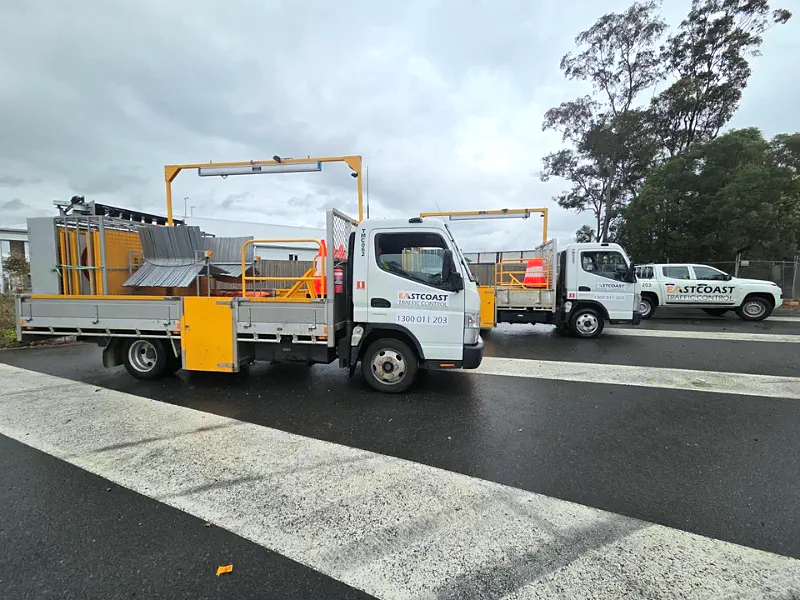
Signs, cones and the crew vehicle are standard. Truck-mounted attenuators, trailer-mounted VMS boards, portable traffic signals, arrow boards, water-filled barriers and lighting towers are priced per unit per day because they are large assets that need transport, set-up and maintenance.
Plan design
A TMP and each TGS must be prepared by an authorised designer (TMD in Queensland, PWZ in NSW). A single standard TGS is quick; a multi-stage highway job with detours, pedestrian management and departures needing RPEQ certification takes days of design time.
Permits and authority fees
Road authorities charge for permits and the permit lead time can hold the job. Brisbane City Council, for example, lists a temporary lane or road closure application fee of $341 excluding GST at the time of review. TMR, Transport for NSW and other councils set their own fees and conditions.
Lead time and changes
Short notice narrows the crew and equipment available and can mean paying to expedite. Changes after the plan is lodged can mean a resubmission and a new permit clock. The cheapest job is the one booked early with a firm scope.
How the drivers change between typical jobs
These are patterns from ECTC's work, not prices. Use them to understand why two quotes differ.
| Job | Crew | Plan and permits | Equipment | What pushes the cost up |
|---|---|---|---|---|
| Driveway or service connection on a 50 km/h local street, daytime | Two accredited controllers, implementer set-out at the start | TGS, often accepted alone by the council; works-on-council-road permit | Signs and cones | Short job hitting the minimum shift; pedestrian detour near shops |
| Reseal or kerb and channel on a council road over several days | Two to four controllers plus a TMI/IMP on site | TMP with a TGS per stage; council permit; QPS or police notification if lanes close | Arrow board, VMS board for advance warning | Night staging to protect trade, repeated set-outs as the work moves |
| Utility or civil work on a 100 km/h state-controlled road | Controllers, TMI/IMP, TMA driver | Full TMP; TMR Traffic Control Permit or TfNSW Road Occupancy Licence; speed zone approval | TMA, VMS, portable signals or boom gates, lighting at night | End-of-queue protection, speed zone signage both sides, RPEQ-certified departures |
| Community event with a road closure | Controllers at each closure and crossing point, implementer, event marshals supplied by the organiser | Event TMP and TGS; council road closure application weeks ahead; police permit; bus operator consultation | Barriers, VMS boards for days ahead, pedestrian fencing | Crowd dispersal peaks, multiple closure points, public holiday rates |
| Emergency or storm response | Whatever the road authority requires, often at short notice and around the clock | Authority-directed; permits handled after the fact where the authority allows | TMA on high-speed roads, VMS for closures | Night and weekend rates, long shifts with crew rotation, remote travel |
How a quote is built at ECTC
Our estimator reads the scope and sketches the likely TGS for the road environment. That gives the number of control points and whether a TMI, TMA or portable signals are required by the Queensland MUTCD Part 3 and QGTTM, or by TfNSW TCAWS. The hours come from your program. The depot nearest the job sets travel. Permit fees are shown as their own line with the lodgement time added. Design is priced separately from the on-road crew so you can see it.
What you receive is a line for design, a line for permits, a daily or shift rate for the crew by tier, and a daily rate per piece of equipment. If a line is missing from a competitor's quote, ask what happens when that item is needed on the day.
What to send for a fast, accurate quote
- Exact location: street, nearest cross street or chainage, and which road authority owns it (council, TMR or Transport for NSW)
- Dates and hours, including whether night, weekend or public holiday work is possible or required
- The work: what is happening on the road, what plant is involved, and whether the work moves
- The layout you need: shoulder closure, lane closure, full closure with detour, shuttle flow, pedestrian or cycle diversion
- Posted speed limit and road type (single carriageway, multilane, intersection, signals nearby)
- Whether you already have a TMP or TGS, and who prepared it
- Whether any permits or consents are already lodged
- Site contact and any client induction, access or safety requirements
- For events: expected attendance, bump-in and bump-out times, and any council correspondence to date
Where buyers lose money
Late planning is the big one. Permit clocks in Queensland run from 5 to 28 business days depending on the authority and the lead time for a NSW Road Occupancy Licence is at least 10 working days, so a job booked a week out either slips or pays for expedited handling. The second is an undersized plan: a quote built on two controllers that turns out to need a TMA and a speed zone is a variation on day one. The third is treating the cheapest hourly rate as the cheapest job; a crew without the right tier on site cannot legally set out the scheme, and a knocked-back plan costs more than the design fee it saved.
The fourth is paying twice for the plan. If you give us a TGS drawn by someone else we will check it against the current standard before we price the crew. If it has to be redrawn, we tell you before the job, not after.
When to bring in ECTC
If you need a number you can put in a tender or a budget, send us the checklist above and we will come back with a line-item quote that includes design, permits, crew and equipment. ECTC has priced and run traffic control in Queensland since 1993 and NSW since 2022, from 13 depots, with designers, implementers, controllers and TMA crews in-house. See roadworks and civil, night works and events for how we run each type of job.
Related pages
Sources
- Fair Work Ombudsman: Building and Construction Award [MA000020] summary (covers traffic controllers)
- Brisbane City Council: Road closure permits (fees and lead times)
- TMR Traffic control permit (10 business days, registered company must apply)
- TfNSW Road Occupancy Manual (minimum 10 working days)
- TfNSW TS 05492:1.0 TCAWS fact sheet (mandatory crash attenuator and end-of-queue measures)
- ECTC: Planning ahead for traffic management
- ECTC: ECTC now TMA accredited
Local depots
Common questions
What is the minimum cost for traffic control?
Every job carries a minimum shift for each person on site plus any plan and permit costs, so even a short task has a floor. The size of that floor depends on the crew the traffic guidance scheme requires, the depot distance and whether a permit applies. We do not publish a figure because it changes with the award and location; ask for a quote.
Why does night traffic control cost more?
Three reasons. Traffic controllers are covered by the Building and Construction General On-site Award, which applies penalty rates to shift, weekend and public holiday work. Night sites need lighting towers, vehicle-mounted lighting and reflective signage. And fatigue management means crews are rotated on long shifts. Reduced traffic at night can still make it the cheaper option overall for a busy road.
Do I pay for the traffic management plan separately?
Yes, and you should expect to. The TMP and each TGS must be prepared by an authorised designer (TMD in Queensland, PWZ in NSW) and the design time depends on complexity. ECTC shows design as its own line so you can see it, and checks any plan supplied by others against the current standard before pricing the crew.
Are permit fees included in a traffic control quote?
At ECTC they are listed as their own line with the lodgement time. Fees vary by authority; Brisbane City Council, for example, publishes a temporary lane or road closure application fee of $341 excluding GST. In Queensland the TMR Traffic Control Permit must be applied for by the registered traffic management company, so we lodge it for you.
When is a TMA truck required and what does it add?
A truck-mounted attenuator is required where the road authority's standard or permit calls for it, which in ECTC's experience is common on state-controlled roads and highways at 80 km/h and above. It adds a vehicle, a trained driver and transport to the site, priced per day. TCAWS in NSW now contains mandatory crash attenuator requirements, and TMR specifies TMA use in Queensland job by job.
How can I keep traffic control costs down?
Book early so the plan and permits are done inside their normal lead times. Give an exact location so travel is priced from the right depot. Group short tasks into one visit to avoid repeated minimum shifts. Fix the scope before lodgement to avoid resubmissions. And use a company with designers, implementers and TMA in-house so nothing is subcontracted at a margin.
Need crews on site?
Send the job and your local Area Manager takes it from there, day or night.